


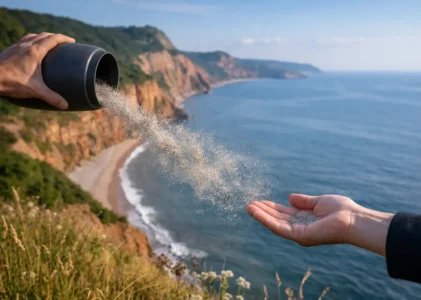
A scattering can be a quiet moment on a familiar cliff path, a gathering at sea, or a family occasion with readings, music and shared memories. Knowing how to arrange ash scattering means there is room for both: the practical arrangements can be handled carefully, while the farewell still feels true to the person who has died.
There is no single right way to do it. Some families wish to scatter ashes soon after the cremation; others need time, or choose to mark a birthday, anniversary or date that held special meaning. What matters is choosing a place, format and pace that feel comfortable for everyone involved.
How to arrange ash scattering: start with the wishes and location
Begin by considering whether your loved one left clear wishes. They may have named a favourite beach, a family garden, a football ground, a woodland walk or a place connected to their working life. If their wishes were not recorded, a conversation among the closest family members can help you decide what would feel most fitting.
It is also worth recognising that not everyone will feel the same about scattering all the ashes. One person may take comfort from a single final resting place, while another may want a small keepsake urn or piece of memorial jewellery. Ashes can be divided, so it is possible to hold a ceremony in one place and keep or scatter a small amount elsewhere. This can be particularly helpful where family members live far apart.
Once you have a location in mind, check who owns or manages it. You will usually need the landowner’s permission to scatter ashes on private land, including farms, gardens, estates and many areas of woodland. For beaches, coastal paths, parks and other public places, contact the local authority, site manager or relevant organisation before making plans. A private garden is often possible with the householder’s agreement, but it is wise to consider how future owners or residents may feel.
Scattering at sea is a meaningful choice for many Devon families. A boat-based farewell gives people time together and avoids the feeling of being rushed by tides, passers-by or weather. If you are arranging a sea scattering independently, choose a suitable location away from swimmers, anglers, harbours and busy moorings, and check any requirements with the boat operator or harbour authority. A professional provider can guide you through the practical details and make sure the occasion is conducted respectfully.
Choose the kind of farewell that suits your family
An ash scattering can be as simple or as structured as you wish. A small gathering may involve only immediate family, with a few words spoken before the ashes are released. A larger ceremony might include a celebrant, favourite music, poems, photographs and time for each person to place a flower on the water or at the chosen spot.
Think about what your loved one would have appreciated. A formal service can offer reassurance when people are unsure what to say, while an informal gathering may better reflect someone who disliked fuss. Neither approach is more loving than the other.
If several people would like to speak, decide in advance who will lead the moment. This person does not need to be a confident public speaker. They simply need to welcome those present, explain what will happen, allow a pause, and invite anyone who wishes to share a memory. Keeping a few written words in a pocket can be a real comfort on the day.
A simple order of events might include an opening reflection, a reading or piece of music, the scattering itself, a period of silence, and a final thank you. Afterwards, families often find it helpful to meet for tea, a meal or a walk. This gives people time to talk without the pressure of the ceremony itself.
Decide who will scatter the ashes
It can be comforting for one close relative to carry out the scattering, but it does not have to be that way. Several people can take turns, or one person can scatter while others stand close by. If children are involved, explain beforehand what they will see and ask whether they would like a role, such as holding a flower, reading a short line or helping to release petals.
Do not assume everyone will want to be present at the point of scattering. Some may prefer to say goodbye before or afterwards, especially if the cremation or funeral was recent. Giving people permission to take part in their own way is a kindness.
Practical preparations for the day
The weather matters more than most people expect. A strong wind can make scattering difficult and may cause ashes to blow back towards those gathered. Visit the site beforehand if you can, note which direction the wind is likely to come from, and have a back-up plan if conditions are poor. At the coast, check tide times as well as the forecast.
Ashes are normally returned in a temporary container or urn. Ask your funeral director about a suitable scattering tube or biodegradable vessel if you would prefer something easier to handle. These can make the process more controlled, particularly on a boat or in a windy place. Keep the container upright during travel and avoid opening it until you are ready.
Natural flowers and petals are often appropriate, but avoid anything that could leave litter or harm wildlife. Artificial flowers, balloons, plastic tributes, confetti and objects that do not break down naturally should not be released into the sea, rivers or countryside. If you would like a visual tribute, consider bringing flowers home afterwards, or placing them at a graveside or memorial area where permitted.
Wear suitable footwear for the ground conditions and allow extra time for parking, walking and finding the exact meeting point. For a coastal location, remember that paths may be uneven and exposed. If an older relative or someone with limited mobility will attend, choose a place that is accessible and has somewhere safe to sit or wait.
Keep the wording honest and simple
You do not need perfect words. A short personal memory is often more moving than a formal speech. You could mention the place you have chosen, thank the person for what they brought to your lives, or read a favourite poem, prayer or song lyric.
Where faith is important, a minister, faith leader or celebrant can offer a blessing or prayer. Where it is not, a moment of silence can carry just as much meaning. Some families ring a small bell, play a recorded song or invite everyone to place a hand on the urn before the ashes are scattered.
Consider a lasting way to remember the place
Unlike a grave or a crematorium memorial, a scattering location may not have a visible marker. That can feel exactly right for some people, especially in a beloved natural setting. For others, it can make anniversaries harder because there is nowhere specific to visit.
A memorial plaque at home, a planted tree where permission has been granted, a framed photograph of the location, or an entry in a memorial book can provide a focus for remembrance. If ashes are scattered in a public place, do not install a plaque, bench or marker without formal permission. Recording the date and the precise location privately can be enough for family members who may wish to return.
It is also sensible to tell close relatives what has been arranged. A brief note with the location, date and any permissions obtained can prevent uncertainty later, particularly if the scattering was held quietly.
When professional support can help
Arranging an ash scattering yourself can be very personal, but it can also feel like a lot to manage when grief is still raw. A funeral director can help with the ashes, suitable containers, transport, celebrant arrangements and advice about permissions. For a sea-based farewell, they can also coordinate the practicalities of the boat and timing.
At Otter Valley Funerals, we understand that families may want a simple private moment or a carefully planned ceremony. The same attention to detail applies to both. Asking for guidance does not make the farewell less personal – it can give you the space to be present for it.
There is no deadline for scattering ashes, and there is no need to follow anyone else’s idea of what a farewell should look like. Choose a place that feels right, make the necessary arrangements with care, and allow the day to unfold at a pace that gives everyone room to remember.