
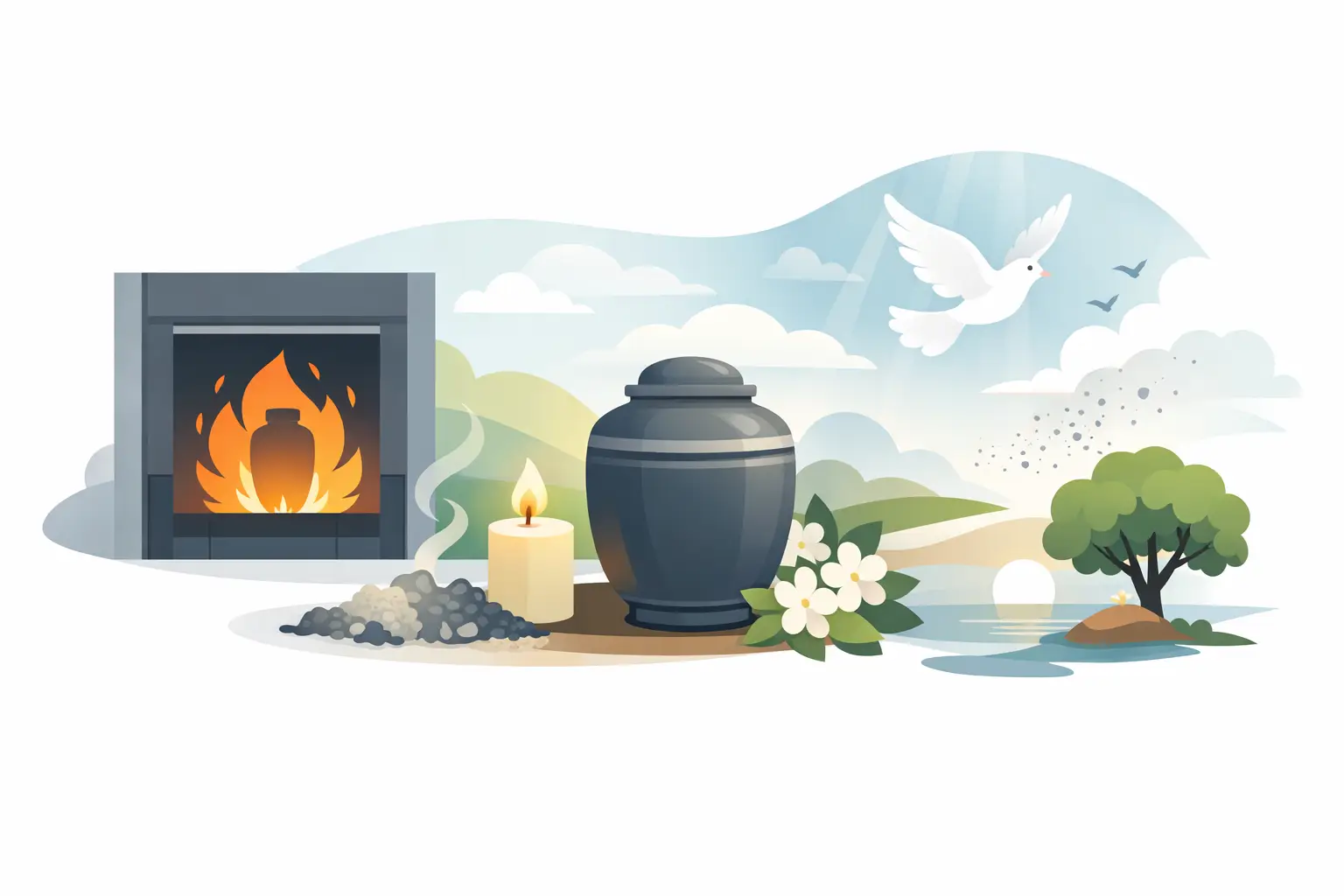

For many families, the question is not just what happens during a cremation, but what happens after cremation – once the service has ended, the mourners have gone home, and the immediate arrangements are over. That quieter stage can feel unexpectedly difficult. Some people know straight away what they want to do with the ashes. Others need time, and that is perfectly all right.
In most cases, after the cremation has taken place, the ashes are carefully prepared and placed into either a temporary container or an urn chosen by the family. They are then made available for collection, or arrangements can be made for them to be scattered or interred according to the wishes that have been expressed. While that sounds straightforward, the practical and emotional side can be more nuanced.
What happens after cremation at the crematorium
Once the cremation is complete, the remaining ash and bone fragments are allowed to cool. These are then processed into a finer, ash-like consistency. The ashes are treated with care and labelled throughout so that the correct remains are returned to the right family.
Most crematoria have clear identification procedures in place, and this is an area where families often want reassurance. That is completely understandable. The process is handled with dignity, and the ashes are usually ready within a set period, often a few days, though timings can vary between crematoria.
If there has been a funeral service before the cremation, the ashes are not normally handed over on the same day. There is usually a short wait while the crematorium completes its procedures and confirms collection arrangements.
How the ashes are returned
Families are usually given a few options. The ashes may be collected by the next of kin or a nominated person. They may be returned via the funeral director if that has been arranged. In some cases, the crematorium can retain them for a limited period while the family decides what to do next.
This can be an important point, because not everyone is ready to make a decision immediately. Grief rarely works to a timetable. Some people feel strongly that the ashes should be scattered quickly in a meaningful place. Others prefer to keep them at home for a while, or permanently. Neither choice is more caring than the other.
If you are unsure, it is often best not to rush. A thoughtful decision made a few weeks later is often easier to live with than one made under pressure.
What can you do with ashes after cremation?
There is no single right answer to this. What happens after cremation depends very much on personal beliefs, family traditions, and the wishes of the person who has died.
Many families choose to scatter ashes somewhere that held meaning – a garden, a beauty spot, the sea, or land linked to family memories. Others prefer interment, where the ashes are buried in a grave, family plot, churchyard, cemetery, or dedicated ashes plot. This can provide a permanent place to visit, which some people find comforting.
Keeping ashes at home is also common. Some families place them in an urn, a casket, or another memorial container. For some, that feels close and reassuring. For others, it can feel like a temporary step until they are ready for a final decision. It is worth remembering that what feels right in the first few days may change over time.
There are also memorial options such as placing ashes in jewellery, incorporating a small amount into keepsakes, or arranging for them to be scattered as part of a private family gathering. These choices can be deeply personal, especially where relatives live in different places or where several people want to remember someone in their own way.
Ash scattering and burial – practical points to consider
Scattering ashes may sound simple, but there are practical matters to think about. Permission is often needed if the location is privately owned. Even in public places, it is sensible to check local guidance. Coastal scattering can be a lovely choice in Devon, but weather and access can make a difference to how the moment feels.
If you are considering burial of ashes, it helps to ask about fees, memorial rules, and whether the plot allows for a marker or inscription. Some churchyards and cemeteries have specific regulations, and natural burial grounds may have their own approach to memorialisation.
These details can feel administrative at a time when emotions are still raw, but clear guidance makes a real difference. A good funeral director will talk through the options in plain terms and help you avoid surprises later.
Do you have to decide straight away?
No. In most situations, you do not need to make an immediate decision about the ashes. Families sometimes worry that there is a correct deadline, but in practice there is often time to think.
That said, crematoria will usually only hold ashes for a limited period. It is wise to check how long that is, and what will happen if no instructions are given. Some people prefer to collect the ashes first and decide later, simply so they feel in control of the next step.
Where there are several close relatives, it can help to have an open conversation early on. Disagreements do happen, especially when one person wants scattering and another wants a permanent resting place. If the person who died left clear wishes, that can guide the decision. If not, a calm discussion about what best reflects their life and values is often the kindest approach.
Emotional responses to ashes are often unexpected
One of the less talked-about aspects of what happens after cremation is how people feel when the ashes are returned. Some are relieved. Some are comforted. Some are surprised by how heavy the container feels, or by how final the moment seems.
There can also be uncertainty. A person may have felt sure they wanted the ashes at home, only to find it unsettling. Another may have thought scattering them would bring closure, only to feel they acted too soon. These reactions are more common than many people realise.
Grief is not made tidier by making fast decisions. If you need time, ask for it. If you need advice, seek it. If you want a quiet, simple arrangement rather than a public event, that is equally valid.
Religious, cultural and family considerations
For some families, what happens after cremation is shaped by faith or custom. Certain religions have particular practices around ashes, burial, prayer, or timing. Others may place more emphasis on memorial services or family gatherings after the cremation has taken place.
Even within one family, views can differ. One relative may want a traditional approach, while another prefers something less formal and more personal. Neither is automatically wrong. The question is what best honours the person who has died and supports those left behind.
This is where sensitive, local support matters. At Otter Valley Funerals, many families want practical help without pressure – especially when they are balancing emotion, family opinion, and the need to make arrangements that feel respectful.
Paperwork and administration after cremation
Although the main formalities are usually completed before the cremation itself, there can still be practical matters afterwards. If ashes are to be buried in a cemetery or churchyard, there may be forms to complete or permissions to arrange. If they are to be taken abroad, additional documentation may be needed.
If the ashes are being divided between family members or incorporated into memorial items, it is sensible to use reputable providers and to make sure everyone understands what is being agreed. These are not decisions to make hastily, particularly where feelings are still tender.
It can also help to keep a simple written note of what has been decided. Families sometimes revisit these arrangements months or years later, and clarity can prevent confusion.
When there is no obvious choice
Sometimes there is no strong wish, no family tradition, and no perfect answer. In that situation, it may help to think less about what is expected and more about what would feel right six months from now.
Would a place to visit bring comfort? Would a scattering ceremony feel meaningful, or too much? Would keeping the ashes at home feel peaceful, or would it make it harder to move through grief? These are gentle questions, but useful ones.
There is no prize for deciding quickly. The most helpful path is usually the one that gives your family room to reflect, remember, and act with confidence rather than pressure.
When someone has died, people often fear getting things wrong. Yet with ashes, as with so much in bereavement, kindness matters more than perfection. The next step does not have to be immediate. It simply needs to be taken when you are ready.