
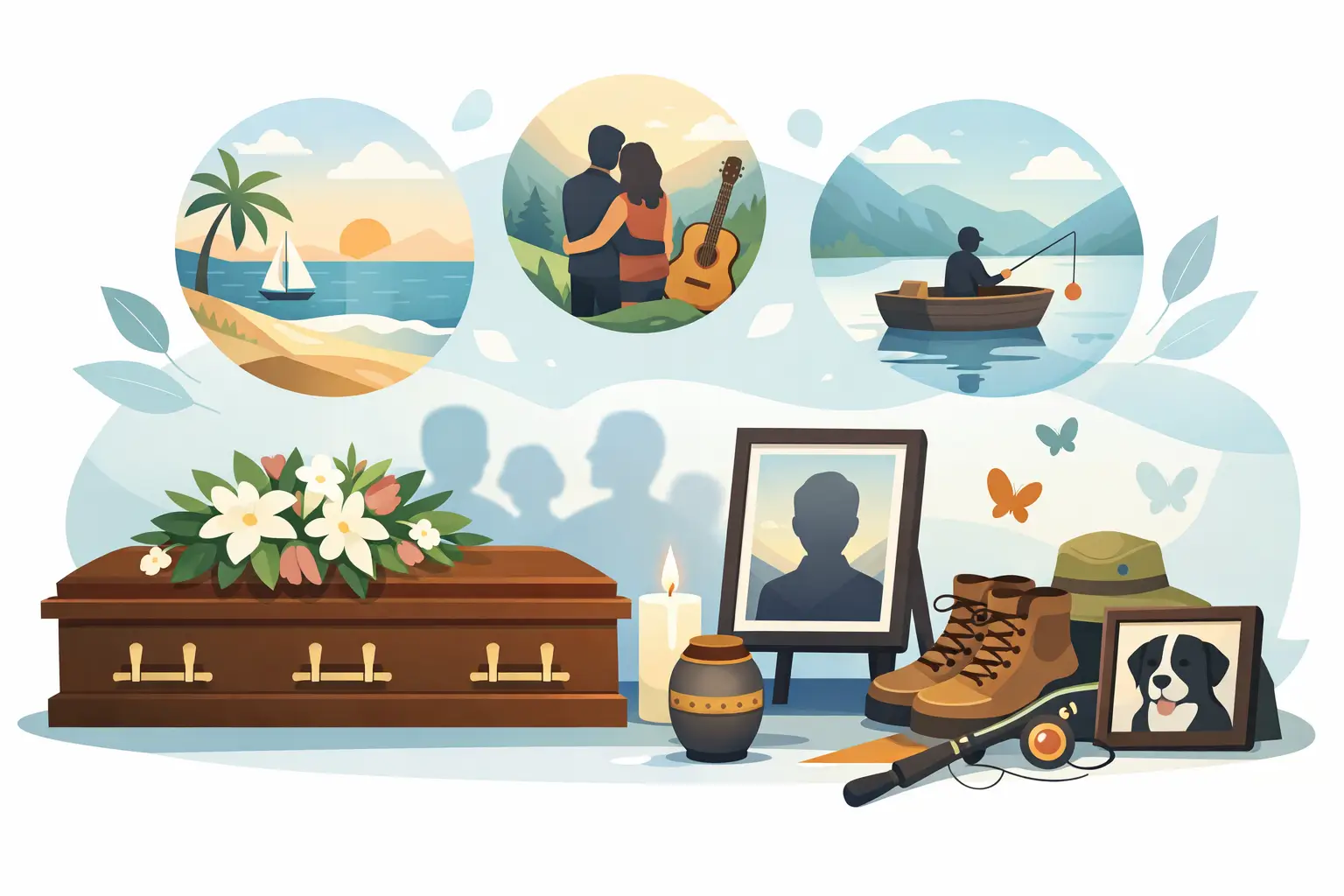

A favourite song playing as people take their seats. A coffin topped with garden flowers instead of formal wreaths. A service by the sea, in a church, or somewhere that simply felt like home. When families ask, can funerals be personalised, the short answer is yes. In most cases, a funeral can be shaped around the person who has died, the needs of those closest to them, and the kind of farewell that feels right.
That said, personalisation does not have to mean something elaborate or expensive. Often, the most meaningful touches are the simplest ones. A familiar hymn, a well-worn photograph, a reading from a grandchild, or a route that passes a favourite place can say far more than anything grand.
Can funerals be personalised in practice?
Yes, and in far more ways than many people realise. Families sometimes worry that funerals follow a fixed pattern and that there is little room for choice. There are practical requirements, of course, and some venues or crematoria have rules about timing, music, or what may happen during a service. But within those boundaries, there is usually plenty of scope to create something personal and sincere.
A personalised funeral might reflect someone’s beliefs, character, work, hobbies, humour, military service, community ties, or favourite surroundings. It can also reflect the family’s needs. Some people want a quiet, traditional service. Others want a celebration of life with colour, stories, and less formal structure. Neither approach is more caring or more respectful. What matters is that it feels honest.
For some families, the right choice is a church funeral with familiar prayers and music because that is what their loved one would have wanted. For others, it may be a woodland burial, a direct cremation followed by a private gathering, or a ceremony with poetry, live music, and personal tributes. Personalisation is not about turning a funeral into an event. It is about making space for the right details.
What parts of a funeral can be personalised?
Almost every part of the funeral can be tailored in some way. The service itself is often where families begin. Music, readings, poems, eulogies, visual tributes, and who speaks can all help tell the story of a life. Some people choose traditional hymns and scripture. Others prefer folk songs, a favourite classical piece, or something unexpected that makes everyone smile through their tears.
The location matters too. A funeral might take place in a church, a crematorium chapel, at graveside, on the water, or in another permitted setting. The setting can change the entire feel of the day. A formal venue may offer structure and familiarity, while a natural burial ground or celebration of life venue may feel gentler and less constrained.
Transport can also be personal. A traditional hearse may feel right for one family, while another may choose something different or simply keep things understated. Flowers can be classic and formal, or gathered from a garden. Dress codes can remain black and traditional, or families may invite guests to wear a favourite colour, bright clothing, or something linked to a loved one’s interests.
Even smaller details can carry real meaning. Orders of service may include personal photographs, a handwritten note, or artwork. Keepsakes, memory tables, candle lighting, or a final toast can all feel appropriate, depending on the family and the setting.
Personalised funerals do not have to be costly
One common worry is that a more personal funeral will always cost more. Sometimes bespoke arrangements do add to the overall cost, especially if they involve a special venue, additional vehicles, extended service times, or live performers. But personalisation is not the same as extravagance.
A simple cremation can still include meaningful music and spoken tributes. A modest burial can still feature favourite flowers from the garden. A direct cremation can be followed by a family-led memorial in a village hall, at home, or somewhere with special significance. The heart of a personalised funeral is thoughtful choice, not spending.
This is often where clear guidance matters most. Families need to know which ideas are straightforward, which may depend on venue rules, and which could affect cost. Honest advice helps people decide what matters most without feeling pressured into extras they do not want.
Traditional or modern – it depends on the person
There is sometimes an assumption that a personalised funeral must be modern or unconventional. In reality, a traditional service can be deeply personal precisely because it reflects a person’s faith, values, and family life.
For one person, personalisation may mean choir music, church bells, and a formal procession. For another, it may mean a natural coffin, wildflowers, and a burial in a meadow. For someone else, it may mean no formal ceremony at all, followed later by a gathering where stories are shared over tea, fish and chips, or a pint in their local.
The question is not whether a funeral looks modern enough or traditional enough. The better question is whether it feels true to the person who has died and supportive to the people who are grieving.
When wishes are known, decisions can feel easier
If someone left funeral wishes, those wishes can be a helpful starting point. They may have said they wanted burial or cremation, a church service, no fuss, bright colours, a favourite song, or donations to a particular cause rather than flowers. Even a few clear preferences can take away uncertainty.
If no wishes were left, families often worry about getting it wrong. That feeling is very common. In practice, the aim is not perfection. It is to make loving, sensible choices based on what you knew of the person and what your family can manage emotionally and financially.
A good funeral director will talk through these choices carefully and help separate what is possible, what is practical, and what is likely to feel right on the day. That support can make a difficult conversation feel much less daunting.
Can funerals be personalised if the family wants simplicity?
Absolutely. Simplicity and personalisation can sit very comfortably together. In fact, many of the most moving funerals are the least complicated.
A short service with one piece of music and a single tribute can be more powerful than a packed programme. A private identification of the person’s favourite flowers, a reading by one close friend, or a quiet ash scattering in a meaningful place can hold enormous significance. Personalisation is not about adding more. Sometimes it is about stripping away what does not fit.
This can be especially important when families are tired, shocked, or managing practical pressures alongside grief. Choosing two or three meaningful elements is often enough to create a farewell that feels personal without becoming overwhelming.
Local touches can mean a great deal
For many families in East Devon, place matters. A route through a familiar town, a service near the coast, flowers from a local grower, or a gathering in a much-loved community setting can make the funeral feel grounded in the life that was lived.
That local understanding is one reason families often prefer an independent funeral director with close ties to the area. Someone who knows the churches, crematoria, burial grounds, celebrants, and local customs can often suggest thoughtful options that a family may not have known were available. At Otter Valley Funerals, that local knowledge is part of helping families create farewells that feel personal rather than standardised.
A personalised funeral should still feel manageable
There is a balance to strike. A funeral can reflect a unique life while still being calm, dignified, and practical to arrange. Too many ideas at once can become stressful, especially when decisions need to be made quickly. It often helps to focus on a few areas that matter most – perhaps the tone of the service, the music, the place, and one final symbolic gesture.
That way, the day remains centred on the person rather than the logistics. Families are then more able to be present with one another, which is usually what they remember most.
There is no single right answer to the question can funerals be personalised, because every family and every life is different. But there is reassurance in knowing that, whether you want something traditional, simple, modern, faith-based, nature-focused, or quietly unconventional, there is usually room to shape a farewell with care. The most meaningful funeral is rarely the most elaborate one. It is the one that helps people recognise the person they loved and say goodbye in a way that feels like them.