


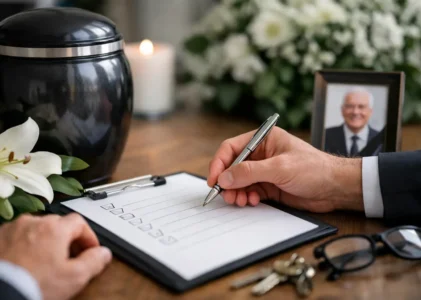
When someone dies, even simple decisions can feel unexpectedly hard. An arranging a funeral checklist can give you a bit of structure at a time when your thoughts may be elsewhere, helping you deal with the practical steps without losing sight of the person you are remembering.
No two funerals are the same, and that matters. Some families want a quiet, simple farewell. Others want a church service, a burial, a greener option, or a more personal celebration of life. A checklist is not there to make the day feel formulaic. It is there to help you move through each decision in a manageable way, at your own pace, with fewer worries about forgetting something important.
Arranging a funeral checklist: first steps
The first step is to confirm who is looking after the immediate arrangements. If the death has occurred at home, in a care home, in hospital, or elsewhere, the process can vary slightly, so it helps to have clear guidance from the relevant professionals and your chosen funeral director.
Very early on, you will usually need to register the death. In England, this is normally done within five days, although there can be delays if the coroner is involved. Once the death is registered, the paperwork needed for burial or cremation can begin to move forward. If this sounds daunting, that is entirely understandable. Many families find this is the point where calm, practical support makes the biggest difference.
It is also worth checking whether the person who has died left any funeral wishes, a prepaid funeral plan, or instructions in a will. Sometimes these are very detailed. Sometimes they are as simple as preferring cremation to burial, asking for family flowers only, or wanting a particular piece of music. Wishes should be considered carefully, but there can still be room for discussion if costs, timing, or family circumstances make one option more realistic than another.
Choosing the kind of funeral
This is often the biggest decision, and it shapes many of the others. A funeral may be a traditional church service, a cremation at a local crematorium, a burial, a woodland or natural burial, a direct cremation without attendees, or a more informal celebration of life. There is no single right choice. The best option is the one that feels appropriate for the person who has died and manageable for the people arranging it.
For some families, tradition brings comfort. For others, simplicity feels kinder and less pressured. If several relatives are involved, opinions may differ. One person may want a formal service while another feels a smaller gathering would better reflect the person’s character. When that happens, it helps to come back to three things: what the deceased wanted, what the family can cope with emotionally, and what is affordable.
Costs do matter, and they should be discussed plainly. A more elaborate funeral is not a more loving one. What people usually remember is whether the day felt respectful, personal, and well cared for.
Practical decisions to make early
Once the broad type of funeral has been chosen, a number of practical arrangements need to follow. These decisions tend to include:
- whether the funeral will be a cremation or burial
- the preferred date and time
- the venue for the service
- whether there will be a minister, celebrant, family-led service, or another officiant
- whether the deceased will rest in a coffin suited to a traditional, simple, or environmentally conscious funeral
- who will act as pallbearers, if required
You may also need to decide whether there will be a viewing or chapel visit before the funeral. Some families find this deeply important. Others prefer to remember the person as they were in life. Both responses are valid.
If family members are travelling from further away, timing may affect what is possible. Equally, some people prefer not to wait too long, finding that a sooner date feels easier. There is no perfect timetable, only what is workable and compassionate in your situation.
Personal details that shape the service
This is the part of arranging a funeral where the service begins to feel less like a list of tasks and more like a true farewell. You may want to think about music, readings, hymns, poems, flowers, dress, transport, photographs, and whether anyone will speak.
If the person had strong views, those can guide the tone. They may have loved a quiet church setting, a favourite seaside place, gardening, military traditions, or a very understated approach. Personal touches do not need to be dramatic to feel meaningful. A favourite cardigan placed on a chair, a chosen colour instead of black, or a single song played at the right moment can say a great deal.
Order of service sheets may also need to be prepared if you want them. These can be simple or more detailed, and they often include the running order, music, readings, and a photograph. If there will be a collection for charity, that usually needs to be arranged in advance as well.
The paperwork and administration
The practical administration after a death can feel relentless, especially in the first week or two. Alongside funeral arrangements, there may be banks to inform, pensions to deal with, household providers to contact, and government departments to notify.
For the funeral itself, make sure all required documents are in place and that you understand who is responsible for each part of the process. If burial is chosen, there may be cemetery forms and grave ownership questions. If cremation is chosen, there will be cremation paperwork and decisions about what happens to the ashes afterwards.
Ashes are another area where families sometimes feel rushed, but there is usually no need to make an immediate choice. They may be collected, buried, scattered, divided between relatives, or kept for a period while the family decides. It is often better to take a little time than to make a hurried decision that does not feel right later.
Informing people and managing expectations
One of the hardest parts can be simply telling people. Close family and friends will usually be told first, then the wider circle. A funeral notice can help with practical details such as date, time, family flowers only, charitable donations, and whether everyone is welcome at the service or wake.
Families are sometimes surprised by how many opinions emerge once arrangements begin. Relatives may mean well, but suggestions can quickly become pressure. If you are the person taking responsibility, it is reasonable to keep coming back to what is manageable. You do not need to meet every expectation.
If there is likely to be tension, having one point of contact can help. That may be a family member, or it may be your funeral director passing on practical information so you are not repeating the same conversations over and over.
The day itself
By the time the day arrives, many families are exhausted. A gentle plan helps. Think through who needs to be where, who is bringing readings, who is greeting guests, and how everyone will travel between locations if there is more than one venue.
This is also the moment to allow for human reality. People may cry, forget words, arrive late, or change their minds about speaking. None of that means the funeral has gone wrong. Often, the most moving moments are the unplanned ones.
If there is to be a gathering afterwards, it does not need to be elaborate. Tea and sandwiches in a village hall, a pub meal, or a simple family gathering at home can all be entirely fitting. The purpose is not to host perfectly. It is to give people a place to be together.
An arranging a funeral checklist should leave room for feeling
A good arranging a funeral checklist is not just about administration. It should also make space for pauses, conversations, and second thoughts. Some decisions will be easy. Others may take longer, especially when grief, family dynamics, and budget all meet in the same room.
This is where experienced support can be invaluable. A compassionate funeral director should not rush you, confuse you, or make you feel that you have to choose the most expensive option. They should help you understand what needs to happen now, what can wait, and how to create a funeral that feels dignified and personal.
For families in East Devon, that often means finding someone local who knows the area, understands the practicalities, and treats your loved one as a person rather than a booking. Otter Valley Funerals is built around that kind of personal care, with guidance that is clear, respectful, and close at hand when families need it most.
If you are facing these arrangements now, try to take one decision at a time. The checklist matters, but so does kindness – to your loved one, to the people around you, and to yourself.