

When a death has just happened, families are often asked to make decisions before they have had time to catch their breath. One of the most common questions is direct cremation vs funeral – and for many people, the choice is not as simple as cost alone. It is really about what feels right for the person who has died, and what will help those left behind.
There is no single best option for every family. Some people want a quiet, uncomplicated farewell. Others need the structure of a service, the presence of family and friends, and a clear moment to say goodbye. Both choices can be dignified, respectful and thoughtful. The difference lies in how and when that farewell takes place.
Understanding direct cremation vs funeral
A direct cremation is a cremation without a funeral service beforehand. The person who has died is cared for, taken to the crematorium, and cremated in a simple and respectful way, usually without mourners present. Ashes are then returned to the family, or arrangements are made according to their wishes.
A funeral, by contrast, includes a service where family and friends can gather. That service may take place in a church, chapel, crematorium, graveside, garden venue or another meaningful setting. It may be formal or informal, religious or non-religious, very traditional or more personal in style.
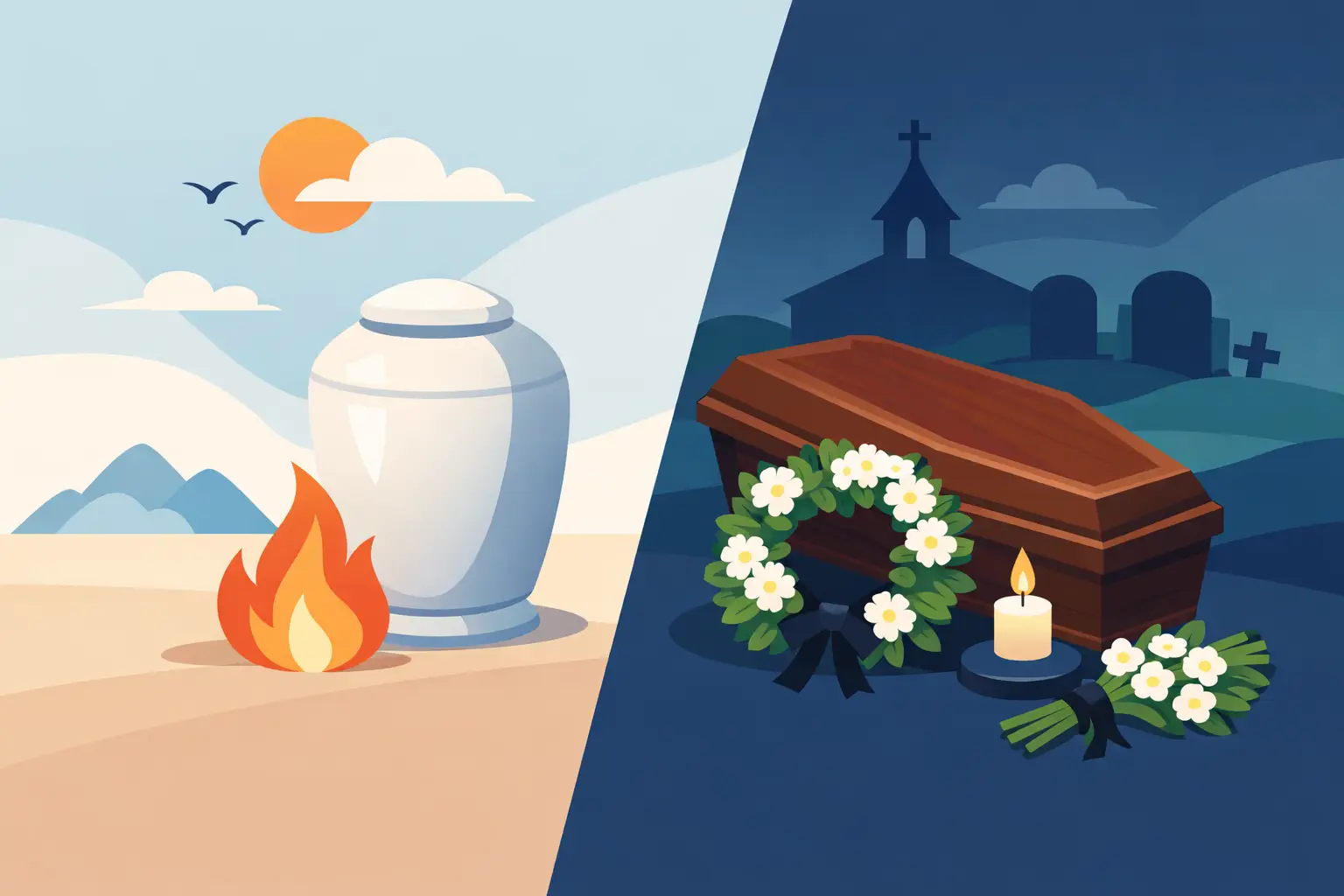
The clearest way to think about direct cremation vs funeral is this: with direct cremation, the practical process happens first and any memorial can take place later if the family wishes. With a funeral, the service is part of the farewell itself.
Why some families choose direct cremation
For some people, direct cremation feels right because it removes pressure at a very difficult time. There is no need to arrange an immediate service, choose music quickly, book a venue, or coordinate large numbers of people while still in shock.
It can also be a good choice when the person who died was very clear that they did not want a fuss. Some families tell us their loved one disliked attention, preferred simplicity, or wanted money to be spent on family rather than ceremony. In those cases, a direct cremation can feel honest and appropriate.
Cost is another factor, and understandably so. A direct cremation is usually less expensive than a full funeral because there is no service, hearse procession, chapel time or many of the added elements that come with a traditional farewell. For families managing tight finances, this can bring real relief.
That said, simple does not mean uncaring. A properly arranged direct cremation should still involve respectful transportation, professional handling, clear communication and dignified care throughout.
Why others prefer a funeral service
A funeral gives people a time and place to come together. That may sound straightforward, but it can matter deeply. When someone dies, grief can feel unreal. Seeing others, hearing shared memories, listening to music and marking the life of the person who has died can help make the loss feel acknowledged.
For many families, a funeral is not about display. It is about witness. It says: this person mattered, and we are here to honour them. Even a very modest service can carry enormous meaning.
A funeral may also suit families with cultural, religious or community expectations around mourning. In some families, gathering together is part of how support is shown. In others, rites and prayers are central to saying goodbye properly. A direct cremation may feel too private or too abrupt in those circumstances.
There is also the question of regret. Some people choose the simplest option in the first days after a death, only to realise later that they needed a collective goodbye. That does not mean direct cremation is the wrong choice, but it is worth pausing to ask what will feel manageable now and what may matter months from now.
Cost matters, but it is not the whole decision
It is natural to compare prices when thinking about direct cremation vs funeral. Funerals can vary significantly in cost depending on the type of service, venue, vehicles, flowers, officiant, notices and other choices. Direct cremation is often the most budget-conscious route.
But the fairest comparison is not cheapest against most expensive. Many funerals can be arranged simply and carefully, without unnecessary extras. Equally, some families choose direct cremation and then hold a separate memorial or celebration of life later, which may involve venue hire, catering or printed orders of service. The final cost can still be lower, but it helps to look at the whole picture.
Transparent pricing matters here. Families should feel able to ask what is included, what is optional, and where there is room to tailor arrangements to suit both budget and wishes.
Timing and flexibility
One reason families consider direct cremation is flexibility. Because there is no immediate service to plan, relatives have more time to think, gather from different parts of the country, or decide on a memorial when emotions are less raw.
This can be especially helpful if family members live abroad, if there is uncertainty about the right kind of farewell, or if someone simply cannot face organising an event straight away. Ashes can be kept until the family is ready for a scattering, interment or private gathering.
A funeral, though, offers a different kind of support through timing. The service creates a clear point in the early days of grief. Many people find comfort in having something to move towards, with practical steps and a date that anchors a difficult week. It depends very much on how a family copes and what kind of support they need.
The emotional side of direct cremation vs funeral
This is often the part people speak about most quietly. Practical decisions are easier to discuss than emotional ones, but they matter just as much.
A direct cremation can feel peaceful, private and gentle. For some, that is exactly what they want. It can spare people the strain of public mourning and allow them to remember their loved one in their own way, in their own time.
For others, the absence of a service can leave a gap. Without a ceremony, there may be no moment that marks the reality of the death. Friends may not know when to offer support. Family members may grieve separately when they would have benefitted from being together.
A funeral can help by providing ritual, even in a modern and informal form. That ritual might be a hymn, a poem, a favourite song, a eulogy, a walk behind the hearse, or simply a room full of people sitting in silence for a moment. These acts do not remove grief, but they can help contain it.
You do not always have to choose one or the other
It is easy to talk about direct cremation vs funeral as though they are opposites, but many families prefer something in between. A direct cremation can be followed by a memorial service later, perhaps in a church, village hall, garden or by the sea. This allows the practical arrangements to stay simple while still making space for remembrance.
Others choose a very simple attended cremation, with only close family present. Some prefer a small graveside gathering, then a larger celebration of life weeks later. The right farewell does not have to fit a standard pattern.
For families in East Devon, where community ties are often strong and personal wishes vary widely, flexibility can make all the difference. What matters most is that the arrangements reflect the person who has died and support the people who love them.
Questions worth asking before you decide
Before making a choice, it can help to ask a few honest questions. Did the person who died ever say what they wanted? Will close family feel at peace without a service? Is the main concern cost, simplicity, timing, privacy, or the need to gather? Would a memorial later feel enough, or would it feel like something important had been missed?
There is no judgement in any of these answers. Some families want the quiet dignity of direct cremation. Some need the comfort of a funeral. Some want a simple cremation now and a personal remembrance later. At Otter Valley Funerals, we know how personal these decisions are, and how much reassurance families need when weighing them.
Choosing between direct cremation and a funeral is rarely about doing what is expected. It is about finding the kindest and most fitting way forward. If a decision feels gentle, respectful and true to the person you are remembering, that is usually the right place to begin.