
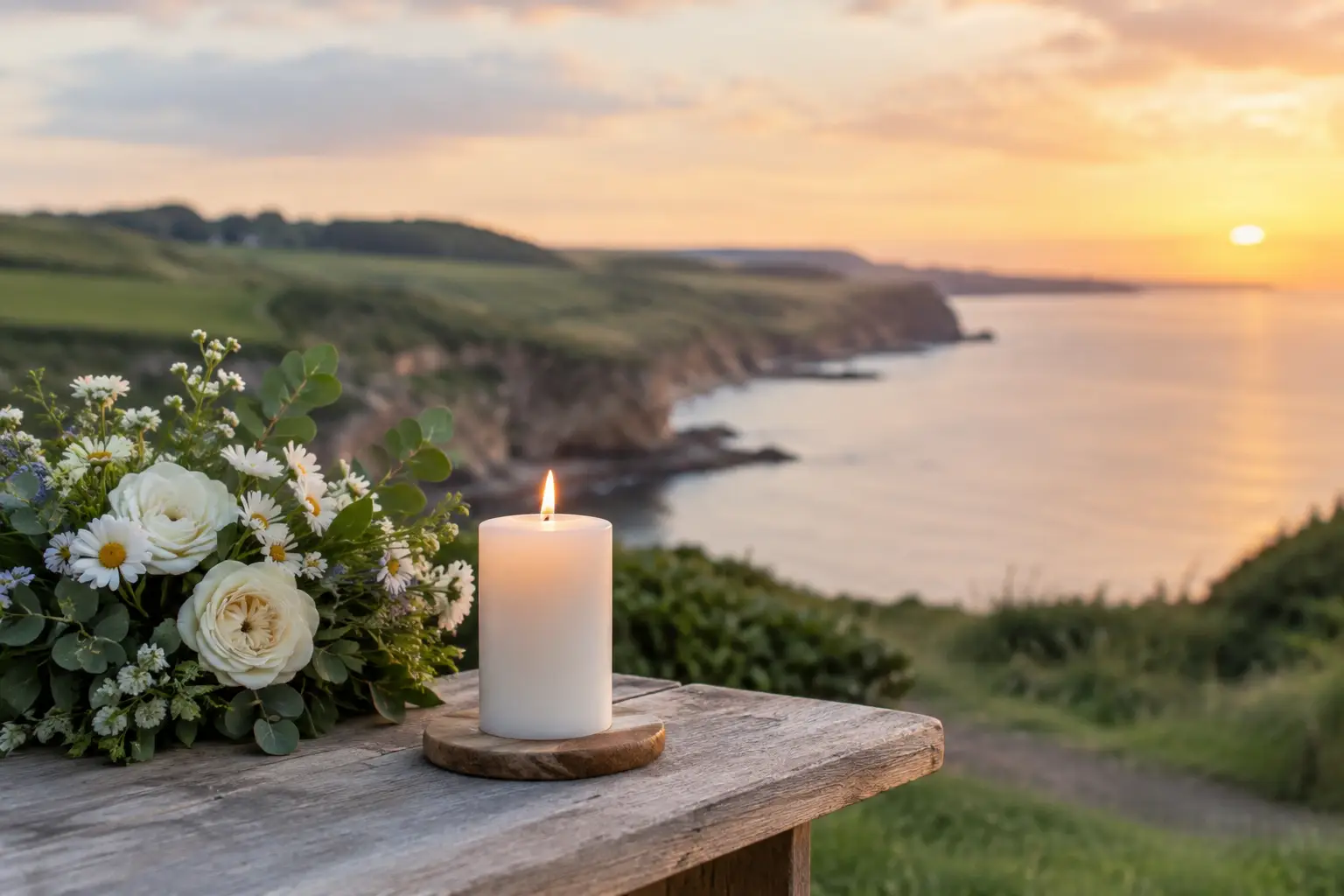

A celebration of life does not need to follow a fixed script. This example celebration of life ceremony is intended as a reassuring starting point for families who want a farewell that feels warm, honest and recognisably personal. You may keep parts that feel right, change the wording entirely, or combine it with a church service, cremation, burial or gathering elsewhere.
The most meaningful ceremonies tend to reflect the person at their centre. That might mean a favourite piece of music on arrival, stories that make people smile through tears, a reading from a grandchild, or a quiet moment beside the sea. There is room for sadness and gratitude in the same service.
What a celebration of life can include
A celebration of life usually lasts between 30 and 60 minutes, although there is no single right length. It can take place at a crematorium, graveside, church, village hall, hotel, family home or another setting that holds meaning. Some families choose a ceremony before a private cremation, while others arrange a memorial gathering after a direct cremation.
The occasion can be led by a celebrant, a member of the clergy, a funeral director, or someone close to the person who has died. A professional leader can provide calm structure at a difficult time and make sure every reader, piece of music and quiet pause has its place. A family-led ceremony can feel especially intimate, but it can also place pressure on someone who is grieving. Often, a middle course works well: a celebrant guides the service while family and friends contribute their own memories.
There is no requirement for religious content. Equally, a celebration of life can include a hymn, prayer or blessing where faith mattered to the person or those closest to them. The important thing is that the ceremony feels truthful.
An example celebration of life ceremony
The following order of service is written for a fictional person, Margaret, whose family wanted a gentle and personal farewell. It can be adapted to suit your loved one’s character, beliefs and wishes.
Arrival and music
Guests enter as a favourite piece of music is played. For Margaret, her family chose a song she played often while cooking Sunday lunch. The music gives people a moment to settle, look at photographs or flowers, and simply be together before the words begin.
Welcome
The celebrant says:
“Thank you for being here today to remember and celebrate the life of Margaret Ellis. We have gathered with heavy hearts because we miss her, but also with grateful hearts for all that she gave: her kindness, her humour, her stubborn determination and the love she showed in so many everyday ways.
“Today is a time to say goodbye, but it is also a time to speak her name, to share the stories that keep her close, and to recognise the mark she leaves on each of our lives.”
A life remembered
This is the main tribute. It may be written by the celebrant after meeting the family, or by a relative who feels able to speak. It need not cover every date and achievement. The details people remember most are often the small ones: the way someone made tea, the garden they tended, their phrase for cheering people up, their loyalty to a local club, or the unwavering welcome at their front door.
For Margaret, the tribute might say:
“Margaret was born in Exeter in 1948, the eldest of three sisters. She became a nurse, raised two children, and never believed anyone should leave her house without being offered something to eat. Her family will remember her practical advice, even when they had not asked for it, and her friends will remember that she was always the first to pick up the telephone when someone needed help.
“She loved the coast in all weathers. A walk in Budleigh, followed by a cup of tea and a slice of cake, was her idea of a very good day. She did not seek attention, but she gave her attention generously to others. That was one of her quiet gifts.”
Readings and memories
One or two readings can add depth without making the ceremony feel crowded. These might be a poem, a short passage, a hymn verse, a letter, or words written by a family member. A grandchild might share a brief memory instead of reading a formal text.
The celebrant can introduce this section simply: “Margaret’s granddaughter, Ella, would now like to share a few words about her Nana.”
Families sometimes worry that speakers will become upset. Tears are welcome, and a pause is perfectly all right. It helps to have a printed copy of the words available for the celebrant to read if needed. No one should feel they have failed if they cannot continue.
A moment of reflection
After the readings, allow time for quiet reflection. This can be accompanied by instrumental music, a favourite song, a candle being lit, or images shown on a screen where the venue permits it.
The celebrant might say:
“We will now take a moment of quiet. You may use it to remember Margaret in your own way: perhaps a conversation, a laugh, a kindness, or simply the feeling of being loved by her.”
A pause of one or two minutes can feel longer than expected, but it gives guests space to absorb the service. It is often one of the parts people remember most.
Farewell words
The farewell marks the point at which the ceremony turns gently towards goodbye. If there is a committal, it may be included here. For a burial, this may happen at the graveside; for cremation, it may take place in the chapel or in private afterwards.
The celebrant could say:
“Margaret, we thank you for your life and for the love you gave so freely. We will miss you deeply. We will carry your voice, your values and your stories with us. May you now rest peacefully, and may those who loved you find comfort in one another.”
Some families prefer a more informal closing, such as: “We will think of Margaret whenever the kettle goes on, whenever the sea is sparkling, and whenever a friend needs us to show up.” There is no need to use language that does not sound like the person you are remembering.
Closing music and gathering
The final piece of music should leave the room in a way that feels appropriate. It might be uplifting, reflective or quietly familiar. Guests may then be invited to a wake, a meal, a walk, or simply to spend time together. The gathering afterwards is not an afterthought. It is often where memories continue to be shared, names are written in a condolence book, and people who have not seen one another for years find comfort together.
Making the ceremony feel personal, not pressured
When arranging a funeral, there can be a feeling that every decision must be exceptional. In reality, a few sincere choices usually mean more than a long programme. Start with the person’s favourite music, the people who knew them best, and two or three memories that capture their character.
Photographs can be powerful, but not every family wants a visual tribute. Some prefer flowers from the garden, a familiar scarf, a football shirt, a collection for a chosen cause or an order of service with a favourite photograph. If the person loved the natural world, a green funeral or natural burial may offer a setting that feels especially fitting. If they enjoyed being by the water, a celebration of life cruise or ash scattering at sea may be considered where appropriate.
Practical details matter too. Check the time allowed at the venue before choosing music and speakers. Ask whether a slideshow can be shown, whether live music is possible, and what the plan is if technology fails. If several people wish to speak, it may be kinder to ask each for a short memory rather than a full eulogy.
At Otter Valley Funerals, families are supported to make these decisions at their own pace, with clear guidance and respectful attention to the details that matter.
Give yourselves permission to keep it simple
A ceremony does not have to be polished to be moving. A voice that trembles, a song that makes everyone cry, a child’s unexpected comment or a shared laugh can be the most authentic moments of all.
Choose what reflects your person, allow room for grief, and let the day be held by the love of those gathered. That is more than enough.