
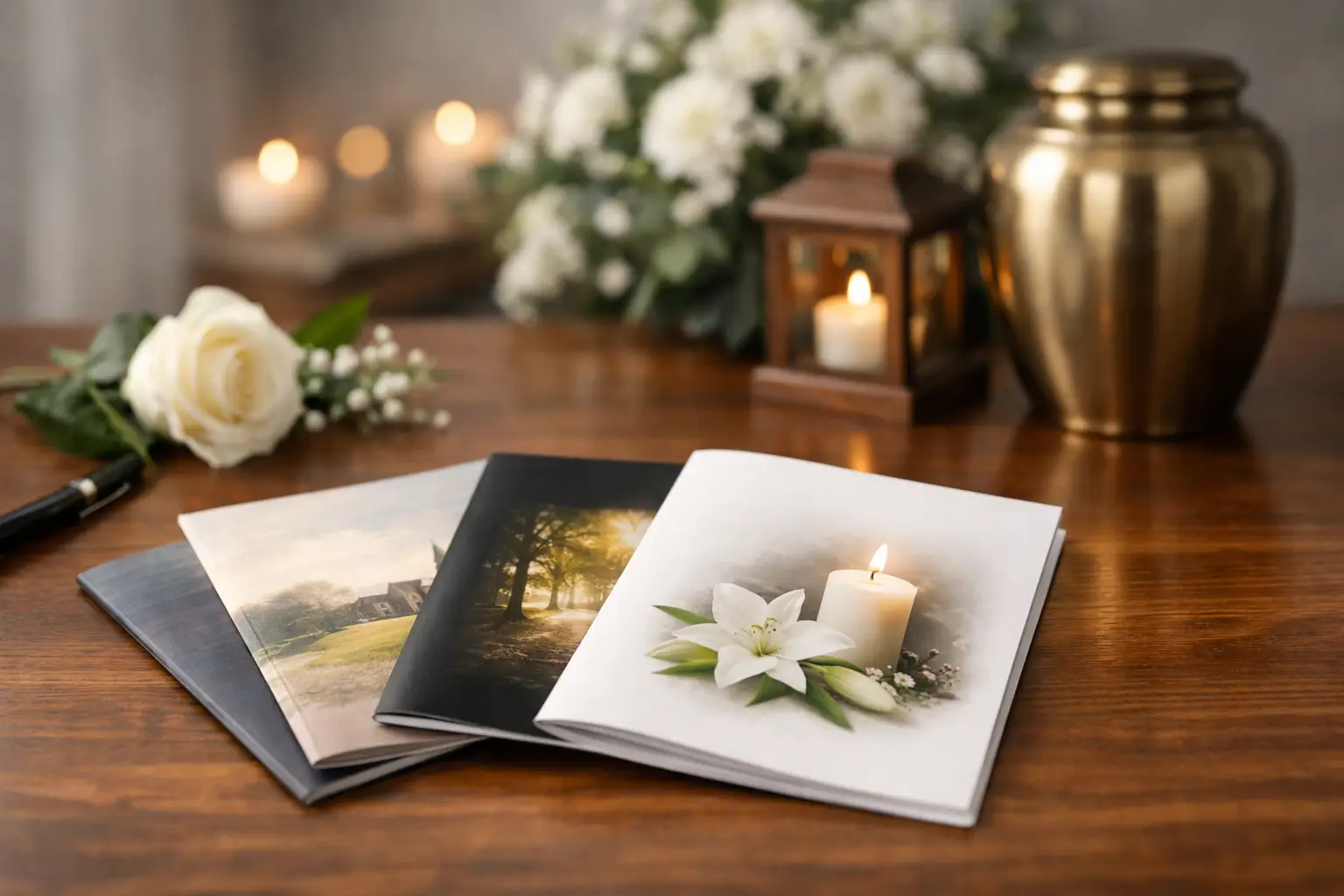

When you are trying to plan a funeral, the order of service can feel like a small detail until you sit down to write it. Then it suddenly carries a great deal of weight. Many families look for funeral order of service examples because they want something simple, clear and respectful, but also personal enough to reflect the life being remembered.
An order of service is, at heart, a guide for everyone attending. It helps people follow the ceremony, know when hymns or readings will take place, and feel included in what can be an emotional and unfamiliar time. It can also become a keepsake, tucked into a drawer or a photo album and revisited years later.
There is no single right format. A traditional church funeral will usually look different from a woodland burial, a cremation service or a celebration of life. Some families prefer formality and structure. Others want something gentle and minimal. Both are entirely valid.
What to include in funeral order of service examples
Most funeral order of service examples share a few core elements. The front cover usually includes the person’s full name, dates of birth and death, and perhaps a favourite photograph. Inside, you would normally set out the sequence of the service, such as music, welcome, prayers, readings, eulogy, reflection and committal.
You may also wish to add the names of those taking part. This can be especially helpful if a family member is reading a poem, a celebrant is leading the service, or grandchildren are carrying out a small tribute. A final page often includes thanks, details of any collection, or an invitation to join the family afterwards.
The balance matters. Too little information and guests may feel uncertain. Too much and the booklet can become crowded. If several people want to contribute words, it is often better to choose one or two pieces for the printed order and keep longer tributes for spoken contributions.
10 funeral order of service examples
1. Traditional church funeral
This is one of the most familiar formats. It often begins with an entrance hymn, followed by a welcome, prayers, Bible reading, address, another hymn, commendation and committal. The wording tends to be formal and reverent.
This style suits families who want a clear liturgical structure and the comfort of tradition. It can be particularly helpful when many attendees are expecting a recognisable church service.
2. Simple crematorium service
A crematorium order of service is often shorter, with a welcome, opening music, tribute or eulogy, reading, reflection, committal and closing music. The wording can be religious, non-religious or mixed.
This works well when families want something straightforward and calm. It also suits smaller gatherings where simplicity feels more fitting than ceremony for ceremony’s sake.
3. Celebration of life service
This example is warmer and more informal in tone. It may include a welcome, favourite song, personal reflections, a life story, readings, a moment of silence and uplifting closing music.
It can feel less sombre, but that does not mean it is less meaningful. For some families, especially when the person was known for humour, music or strong community ties, this style feels honest and natural.
4. Humanist funeral
A humanist order of service usually avoids religious language altogether. It may include an opening welcome, thoughts on the person’s life, family tributes, poetry, quiet reflection and farewell words.
This format is often chosen when faith was not central to the person who has died. It gives space for warmth and personality without borrowing rituals that may not feel true to them.
5. Woodland or green funeral
A green funeral order of service is often minimal and understated. It may include a short welcome, natural pause for reflection, poem, tribute, committal and perhaps a closing piece of acoustic or instrumental music.
Families often prefer recycled paper, soft colours and simple design here. The tone tends to be peaceful rather than formal, though it still needs enough structure for guests to follow comfortably.
6. Military or service funeral
Where someone served in the Armed Forces or emergency services, the order of service may include references to their role, medals, standards, a bugle call or formal salute. The printed wording is often dignified and restrained.
This can be a deeply important choice for service families. The detail needs care, especially where protocol or particular honours are involved.
7. Catholic funeral Mass
A Catholic order of service is usually more detailed because the Mass has set responses, prayers and hymns. Guests who are less familiar with Catholic liturgy often appreciate having these printed clearly.
This type of booklet can run longer than others. That is normal, and it is worth allowing space so the text remains easy to read.
8. Funeral with multiple family tributes
Sometimes the order of service needs to reflect several voices. For example, one reading from a daughter, a short memory from a friend, a poem from grandchildren and a main eulogy from a son.
This can be very moving, but it does need careful pacing. A service can become emotionally heavy if too many long pieces are included one after another, so shorter contributions often work best.
9. Direct cremation memorial service
Where a direct cremation has taken place earlier, the memorial order of service may be more flexible. It might include welcome drinks, music, tributes, photo reflection, a candle-lighting moment and closing thanks.
Because there is no committal taking place in the room, families often feel freer to shape the gathering around the person rather than around a set format. That can be comforting, though some people still prefer a clearer structure.
10. Very small family-led farewell
For a quiet service with only a few close relatives, the booklet may be just a folded card. It could include the name, dates, one photo, a poem and the running order in a few lines.
This is a good reminder that not every funeral order of service has to be elaborate. Sometimes the simplest version feels the most sincere.
How to choose the right wording
The best wording usually sounds like the person, not like a template pasted in at the last moment. If they were formal and private, a bright and chatty tone may feel wrong. If they were warm, sociable and full of life, very stiff language can seem distant.
A good place to start is with the front cover and opening line. “A service to celebrate the life of” is common for a more personal ceremony. “In loving memory of” is timeless and gentle. A church service might simply use the person’s name with “Funeral Service” beneath.
Inside, keep descriptions clear. “Reading”, “Eulogy” and “Committal” are usually enough. There is no need to over-explain every moment. If a piece of music had special meaning, though, it can be lovely to include the title and artist or composer.
Design details that make a difference
Families often worry about getting the design perfect, but readable and thoughtful is far more important than elaborate. A clear font, good spacing and one strong photograph usually work better than lots of decorative elements competing for attention.
Colour can be used sensitively. Soft blues, greens or cream tones can feel calm. Black and white remains entirely appropriate. Some families choose a favourite flower, seaside image or countryside scene if it reflects the person’s life in a genuine way.
Paper choice matters too. A thicker card cover can turn the order of service into a keepsake, while a simple folded sheet may suit a modest service better. It depends on budget, the style of funeral and what feels proportionate.
Common mistakes to avoid
The most common issue is leaving it too late. Once readings, music and names start changing, small errors can creep in. Give yourself enough time to check spellings, hymn numbers, dates and the order of speakers.
Another mistake is trying to include everything. A funeral cannot hold every story, every favourite song and every photograph. Choosing with care is kinder to guests and often creates a more meaningful service.
It is also worth checking whether attendees are likely to need help following the service. If many guests are elderly or unfamiliar with the setting, a clearer, slightly fuller order of service can be reassuring.
A simple funeral order of service example layout
A practical layout might look like this: front cover with name, dates and photo; inside left with a short verse or personal line; inside centre with the running order; inside right with music details and names of contributors; back page with thanks and details of any charitable donation or gathering afterwards.
That basic structure works for many different types of funeral. It can be adapted for faith, non-faith, formal or informal services without becoming complicated.
If you are arranging a funeral in Exmouth, Budleigh Salterton or nearby, having someone guide you through these details can take a real weight off your shoulders. The right order of service does not have to be grand. It just needs to help people gather, remember and say goodbye in a way that feels true.