
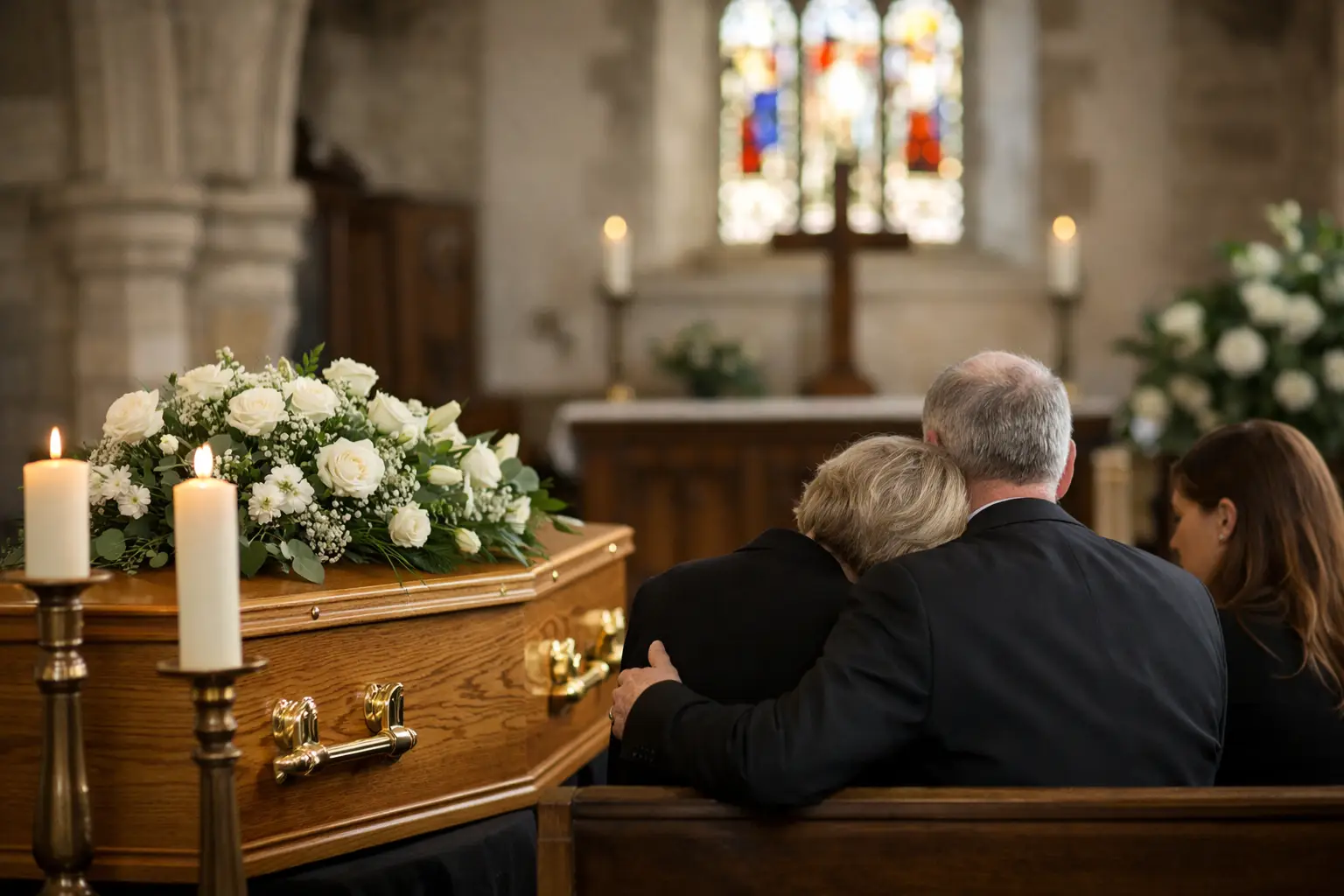

For many families, church funerals provide something deeply reassuring at a time when little feels certain: a familiar building, words of comfort, music that carries memories, and a service shaped by faith. Whether your loved one attended church regularly or simply felt connected to their local parish, a church funeral can be a meaningful way to say goodbye.
There is no single right way to arrange a funeral. Some families want a traditional service followed by burial or cremation; others prefer a short, simple ceremony with a few personal touches. The role of a caring funeral director and minister is to help you understand the choices without making the process feel overwhelming.
What happens at a church funeral?
A church funeral is a service held in a church, chapel or other place of worship, usually led by a minister, priest, vicar or celebrant. It gives family and friends time to gather, reflect on the person who has died, give thanks for their life and, where appropriate, express the hope and comfort of faith.
The coffin may be brought into the church before the service or carried in as mourners arrive. The service commonly includes a welcome, prayers, hymns or other music, a reading, a tribute, and a committal. The committal may take place afterwards at a cemetery, churchyard or crematorium.
The order is flexible. A minister will usually meet with the family beforehand to learn about the person who has died and discuss the words, readings and music that feel right. This conversation is not a test of religious knowledge or church attendance. It is an opportunity to create a service that is honest, respectful and comforting.
Is a church funeral only for regular churchgoers?
No. Families sometimes worry that they cannot ask for a church service because their loved one had not attended recently, or had never been a regular member of the congregation. In many cases, this need not prevent a church funeral.
A connection may come through where the person lived, where they were baptised or married, family history, military service, or a longstanding affection for a particular church. The best approach is to speak openly with the minister or funeral director about your circumstances. Availability and local church practice can vary, but a compassionate conversation usually brings clarity quickly.
A church funeral can also suit someone whose beliefs were private or mixed. The service can retain its Christian framework while making space for a personal tribute, favourite music where permitted, and words that reflect the individual rather than making assumptions about them.
Choosing between a church, crematorium or graveside service
The setting affects the feel and practical arrangements of the day. A church offers space, tradition and the support of a faith community. It can be especially meaningful when the building has been part of family life for generations.
A crematorium service may be more straightforward where the cremation follows immediately, while a graveside service can feel intimate and simple. Some families choose a church service first and then travel together to the crematorium or cemetery. Others hold a small committal and arrange a separate memorial service later, when more people can attend.
There is no need to choose the most elaborate option to show love or respect. The right choice is the one that reflects the person who has died and feels manageable for those closest to them.
Planning the service with care
Once a church and minister have been confirmed, the details can be considered one at a time. Your funeral director can liaise with the church, arrange transport for the coffin, confirm timings, organise floral tributes and provide practical guidance for the day.
Music is often the part families remember most clearly. Traditional hymns can bring comfort when a congregation wants to sing together, while an organ piece, recorded song or quiet instrumental music may better suit another person. Churches have their own guidance on what can be played during a service, so it is wise to discuss preferences early.
Readings may come from the Bible, poetry or a piece of prose that captures the person’s character. A family member or friend may feel able to read, but there is no pressure. The minister can read on their behalf, particularly when grief makes speaking difficult.
A eulogy or tribute is another important choice. It may be written and delivered by a relative, shared between several people, read by the minister, or kept brief. It does not have to describe every chapter of a life. Often, a few well-chosen memories – their humour, generosity, work, family role or favourite places – say far more.
The committal, burial and cremation
If there is a burial, the committal usually takes place at the graveside after the church service. In some cases, the churchyard may be an option, although space and local regulations can affect this. A funeral director can explain the arrangements and help check what is possible.
For cremation, the funeral party may travel from the church to the crematorium for a short committal. Some families attend this part; others prefer the funeral director to accompany their loved one privately. Neither choice is more caring. It depends on what the family feels able to do.
You may also choose to have the full service at the crematorium with a minister leading it, followed by a memorial gathering at a church hall, home or local venue. This can be a practical alternative when travel, mobility or timings need careful consideration.
How personal can a church funeral be?
Very personal. Faith and tradition can provide a gentle structure, but the service should still feel like it belongs to the person being remembered. Photographs at the entrance, a favourite flower on the coffin, a meaningful colour in the floral tributes, a service sheet with a photograph, or donations in lieu of flowers can all add a quiet personal touch.
If your loved one was known for supporting a particular cause, the collection can be directed towards a charity or local organisation that mattered to them. A wake or gathering afterwards can also offer a less formal space for stories, food and companionship.
It is worth remembering that not every tribute has to happen during the church service itself. Keeping the service calm and focused, then sharing longer memories at the wake, can be easier for both the family and the congregation.
Costs and practical questions
The cost of a church funeral will usually include church fees, the minister’s fee, and fees for an organist or verger where required. These are separate from funeral director charges, cremation or burial fees, transport, coffin choices, flowers and printed orders of service.
Costs vary according to the church, the type of service and the arrangements that follow. Asking for a clear, itemised estimate early on can remove uncertainty and help you decide where to spend and where to keep things simple. A meaningful funeral does not depend on expensive additions.
It can also help to consider accessibility. Let the church and funeral director know if guests may need step-free access, nearby parking, reserved seating, wheelchair space, hearing assistance or help with transport. These details are easy to overlook when emotions are raw, but they can make a real difference on the day.
Support when decisions feel difficult
In the first days after a death, even small decisions can feel heavy. You do not need to have every answer before making contact. A good funeral director will listen first, explain the available options in plain language and take care of the arrangements that can be handled on your behalf.
For families in Budleigh Salterton, Exmouth and across East Devon, Otter Valley Funerals can work closely with local churches and ministers while keeping the family at the centre of every decision. The aim is not to rush you towards a standard package, but to create a farewell that feels fitting, practical and sincere.
A church service can offer a pause from the demands of arranging and coping. In the shared silence, the familiar words and the memories spoken aloud, families often find a little room to grieve together – and to recognise how much one life has meant.