

A funeral journey can be one of the most visible parts of the day, but it does not need to follow a fixed pattern. Funeral transport options explained simply means considering how your loved one will travel, how close family and friends will travel, and whether the journey itself could reflect a life, a place or a personal wish.
Some families find great comfort in a traditional hearse and cortege. Others prefer a quieter arrival with no procession, or an alternative vehicle that feels more personal. There is no single right choice. The most fitting arrangement is the one that feels manageable, respectful and right for your family.
What funeral transport includes
Funeral transport usually covers more than the vehicle carrying the coffin. It can include bringing the person who has died into the funeral director’s care, taking them to a church, crematorium, burial ground or natural burial site, and moving floral tributes where required.
It may also include cars for close family members, known traditionally as limousines, as well as practical planning for the route, timing and arrival. A funeral director can coordinate these details with the venue and advise on what will work well, particularly where parking is limited or guests have mobility needs.
The vehicle carrying the coffin is only one element of a funeral. Choosing a modest option, or deciding not to have a cortege at all, does not lessen the care or dignity given to the person who has died.
Funeral transport options explained: the main choices
A traditional hearse
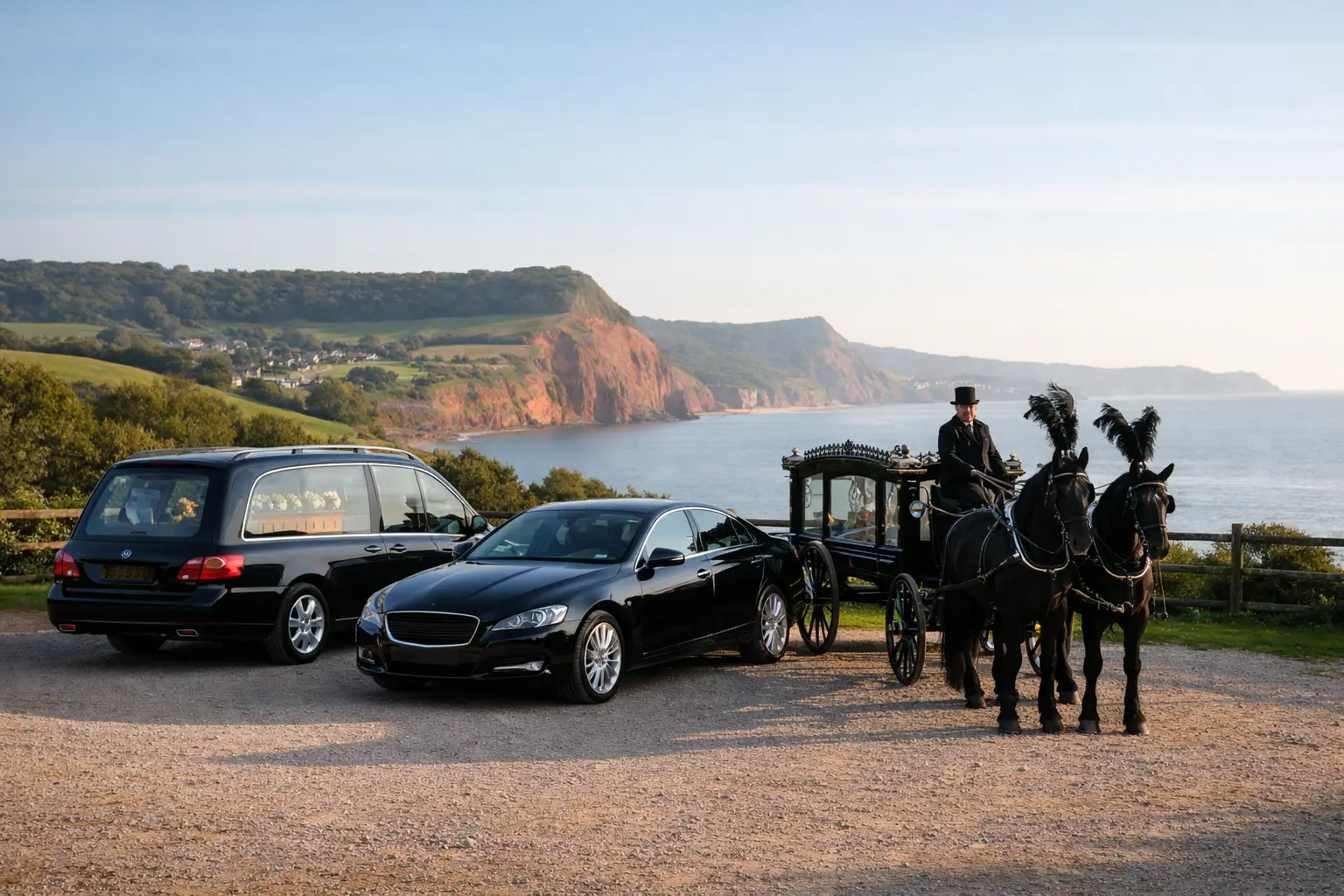
A traditional hearse remains a meaningful choice for many families. Usually black, though other colours may be available, it offers a formal and recognisable way to bring someone to their service. Family members may choose to follow behind in accompanying cars, or make their own way to the venue.
For some, the hearse creates a gentle sense of occasion and gives mourners a clear moment to gather their thoughts. It can be particularly appropriate for a church funeral, burial or service attended by a large number of people. It also allows space for floral tributes to travel with the coffin.
A traditional hearse is not, however, a requirement. A simpler arrangement may be more suited to a private funeral, a direct cremation or a family who would rather focus their spending elsewhere.
Family cars and limousines
Funeral cars can take close family members to and from the service. They can be helpful when people are distressed, do not wish to drive, or would value travelling together before the funeral begins. They also reduce the worry of finding parking or arriving separately.
Most funeral limousines accommodate several passengers, but exact capacity varies. If there are more people than one car can carry comfortably, additional vehicles may be arranged or family and friends can follow in their own cars.
Travelling together is often less about formality than support. It gives immediate family a little protected time away from the demands of the day. Equally, some people prefer the independence of driving themselves. Both choices are entirely valid.
A private procession in your own vehicles
A cortege does not have to include funeral cars. Families may follow the hearse in their own vehicles, or simply meet it at the service venue. This can be a sensible choice where guests are travelling from different directions, where the journey is very short, or where a loved one wanted a low-key farewell.
If people are driving themselves in a procession, it is helpful to keep the route straightforward and allow plenty of time. Drivers should never feel pressured to keep close together at the expense of road safety. The funeral director can explain the planned route and expected timings so everyone knows where they need to be.
Horse-drawn and alternative hearses
An alternative hearse can add a deeply personal touch. Depending on availability and the nature of the funeral, this could include a horse-drawn carriage, a vintage vehicle, a motorcycle and sidecar hearse, or a vehicle connected to a particular interest or career.
These choices are memorable, but they need careful consideration. A horse-drawn cortege travels at a slower pace and may be best suited to a shorter route. Weather, road conditions and access at the venue can all affect what is practical. Specialist vehicles can also cost more than a standard hearse and may need to be booked well in advance.
The aim is not to choose something unusual for its own sake. An alternative vehicle works best when it genuinely says something about the person being remembered, whether that is a lifelong love of horses, a connection to motoring, or a wish for a less conventional funeral.
Transport for a green or natural burial
For a green funeral or natural burial, families sometimes prefer transport that feels less formal and more in keeping with the setting. A standard hearse may still be the best practical option, while others may ask about a more understated vehicle or a hand-carried coffin for the final part of the journey.
Natural burial grounds can have uneven paths, restricted access or weather-dependent ground conditions. This is where experienced planning matters. The final approach needs to be safe and dignified for bearers, family members and the coffin, while respecting the character of the site.
Direct cremation and simple arrangements
With a direct cremation, transport is normally arranged privately between the funeral director and crematorium, without a service or mourners attending. This is often chosen because it is straightforward and more affordable, or because a family plans to hold a memorial gathering at a later date.
A simple cremation with a small attended service may involve a hearse, or it may use more modest arrangements depending on the family’s wishes. It is worth asking exactly what is included in any price, especially if transport between locations, out-of-hours collection or additional mileage may apply.
Choosing what feels right
When deciding on transport, start with the needs of the closest family. Do they want a moment of procession and togetherness, or would a quiet arrival feel easier? Consider the number of passengers, the distance involved, the service location and whether anyone needs step-free access or assistance getting in and out of a vehicle.
It can also help to think about the person who has died. Did they enjoy tradition, or did they prefer things plain and unfussy? Would they have valued a formal cortege through familiar streets, or would they have wanted everyone to meet at the church, crematorium or burial ground without fuss?
Cost is a reasonable consideration, not something to feel guilty about. Transport choices can be adapted to the budget without compromising kindness or care. A clear, itemised estimate allows families to understand the difference between one vehicle, several family cars, a longer route or a specialist hearse before making a decision.
Small details that make a difference
The journey can be personalised in quiet ways. The hearse may pause outside a family home, workplace, club or another meaningful place if the route and timing allow. Pallbearers may walk for a short section of the journey, or family members may choose particular music for the arrival at the service.
These details should always be planned with care. Busy roads, narrow lanes, access restrictions and the schedule at the venue may limit what is possible. In Exmouth, Budleigh Salterton and surrounding villages, a locally experienced funeral director can often suggest a practical route while respecting the places that mattered to your loved one.
You do not have to decide every detail immediately. A caring funeral director will talk you through the available transport, explain the likely costs and timings, and give you space to choose. The right journey is simply one that brings your loved one to their farewell with dignity, and gives those closest to them the reassurance of being properly looked after.