

A funeral can reflect the way a person lived: with care for family, community and the natural world. For many people, the best eco-friendly funeral choices are not about getting every detail perfect. They are about making considered decisions that feel right for the person who has died, while reducing unnecessary environmental impact where possible.
There is no single option that suits every family. Religious wishes, the location of a burial ground, budget, time pressures and the need for relatives to gather all matter. A compassionate funeral director can explain the practical differences clearly, so that environmental concerns sit alongside dignity, personal wishes and the support your family needs.
What makes a funeral more environmentally considerate?
The environmental impact of a funeral can come from several places: the preparation and transport of the person who has died, the coffin or shroud, burial land, cremation energy, flowers, printed materials and travel by mourners. Looking at the whole funeral, rather than focusing on one item, often leads to the most meaningful choices.
It may help to begin with two questions: what would have mattered most to them, and where can we avoid waste without making the day feel less personal? A simple service with local flowers, fewer journeys and a biodegradable coffin may be a better fit than a highly elaborate arrangement. Equally, a traditional church service followed by a thoughtful natural burial can be a deeply personal, lower-impact choice.
Best eco-friendly funeral choices to consider
Natural burial
Natural burial is often the option families think of first. The person who has died is buried in a woodland, meadow or other dedicated natural burial ground, usually in a biodegradable coffin, casket or shroud. Graves may be marked by a tree, a simple plaque or their recorded location, rather than a conventional headstone.
These sites are managed differently, so it is worth asking specific questions. Some are existing woodland, while others are creating new habitats. Their rules on grave depth, memorials, flower tributes and the materials permitted can vary. A natural burial may also require a little more flexibility over location, as the nearest suitable ground may not be close to the family home.
For families in East Devon, a natural burial can offer a calm and beautiful setting for a small gathering. It can feel particularly fitting for someone who loved gardening, walking, wildlife or the coast and countryside. However, this choice is not automatically the least expensive, as burial-ground fees and the cost of the plot differ between sites.
A biodegradable coffin or shroud
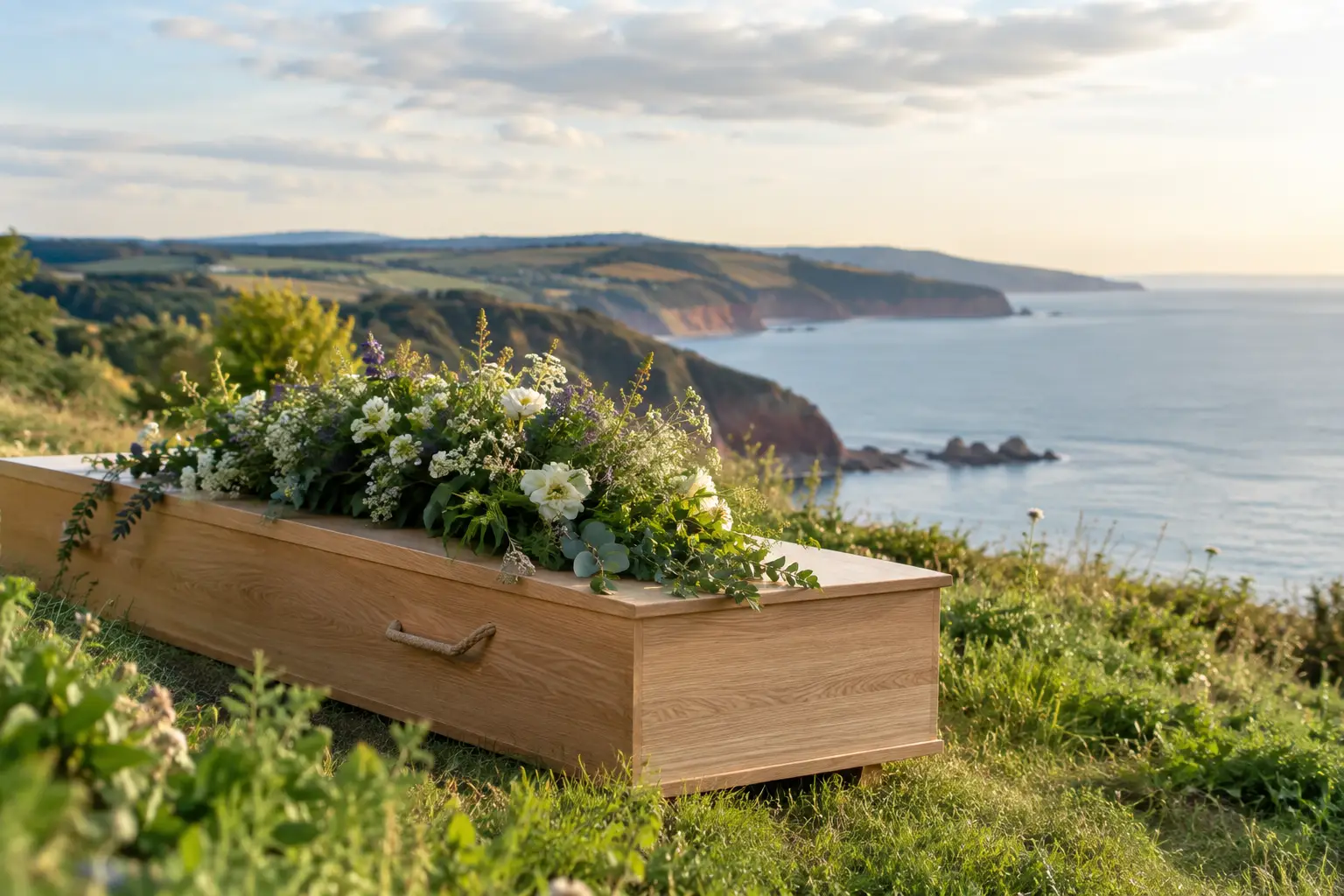
A coffin can be chosen for both burial and cremation. Options include sustainably sourced wood, cardboard, willow, bamboo, wool or other natural materials. A simple wooden coffin may also be an environmentally considerate choice, especially when it is made from certified timber and has minimal fittings or finishes.
The best material depends on the funeral arrangement and the rules of the crematorium or burial ground. Natural burial grounds commonly specify what they will accept, and some biodegradable options are not suitable for every setting. A shroud can be a gentle and traditional alternative, but it needs a suitable bearer or coffin board for safe handling.
There is no need for a choice to look plain unless that is what the family wants. Many biodegradable coffins can be decorated with photographs, messages or artwork from children and grandchildren, creating a tribute that is both personal and less wasteful.
Cremation with thoughtful choices around it
Cremation uses energy and produces emissions, so it is reasonable for families to ask about its environmental impact. Crematoria continue to improve filtration, equipment and operating practices, but the available facilities differ from place to place. If cremation is preferred, there are still several ways to keep the wider funeral more considered.
Choosing a coffin with fewer artificial materials, avoiding plastic adornments, using local seasonal flowers and reducing unnecessary car journeys can all make a difference. Some families hold a service at the crematorium, while others choose a direct cremation and arrange a separate memorial at a time and place that feels right.
Direct cremation is a cremation without a formal attended service at that point. It can be a simpler, more affordable option, particularly when relatives live far apart or when the person who died did not want a formal funeral. It does not change the energy used for cremation itself, but it may reduce some of the additional travel, printed items and venue arrangements associated with a larger service. The ashes can then be kept, scattered where permitted, or used to create a personal memorial.
Local, seasonal flowers and living tributes
Funeral flowers are a loving gesture, but imported flowers, floral foam and single-use plastics can add avoidable waste. Asking for seasonal British-grown flowers, foliage and potted plants is a thoughtful alternative. A planted bowl, a small tree or packets of wildflower seeds can also be taken home by mourners or donated to a community space, where appropriate.
For some families, a simple hand-tied bouquet placed on the coffin says more than large arrangements. Others may prefer donations in memory of the person, rather than flowers. Neither approach is more caring – it is about choosing a tribute that feels genuine.
Fewer printed items and lower-travel arrangements
Orders of service can be important keepsakes, especially for a church funeral or celebration of life. If you would like them, they can be designed simply and printed in the right quantity, avoiding unnecessary extras. Readings, music and details of charitable donations can also be shared digitally afterwards for those who were unable to attend.
Travel is another area where small changes can help. Holding the service, wake and burial or cremation close together can limit journeys on the day. Car sharing, a single family vehicle or asking people not to feel obliged to send flowers from far away are practical options. Families should not feel guilty if elderly or vulnerable relatives need individual transport and support – care for people comes first.
Choosing burial, cremation or a direct cremation
The right decision is rarely made on environmental grounds alone. Some people feel strongly about being buried, perhaps alongside a spouse or in a family grave. Others have always wanted cremation, a church funeral or a quiet farewell with no service. Those wishes deserve proper weight.
A conventional burial can be made more environmentally considerate through the coffin, clothing, flowers and memorial choices, even if a natural burial ground is not suitable. Likewise, cremation can be accompanied by a meaningful, low-waste memorial. The kindest approach is to understand the available options without placing pressure on yourself to choose a perfect solution.
If pre-planning your own funeral, writing down what matters most can spare relatives from uncertainty. You might state a preference for a natural coffin, donations instead of flowers, a small gathering, or a particular place for ashes to be scattered, subject to permission. It is also helpful to tell someone where those wishes are kept.
Questions to ask your funeral director
A good funeral director should be comfortable discussing environmental choices honestly, including their limitations. Ask which coffins or shrouds are accepted locally, whether a natural burial ground has particular requirements, and what arrangements are possible for a service before or after a direct cremation.
You can also ask how transport will be organised, whether you may provide your own flowers, and which elements of a package are optional. Clear prices and plain explanations make it easier to decide where spending will bring comfort and where a simpler choice would be preferable.
At Otter Valley Funerals, families can talk through these decisions at their own pace, whether they are arranging an immediate funeral or recording wishes for the future. The aim is not to persuade anyone towards one type of funeral, but to make sure the arrangements are respectful, practical and true to the person being remembered.
A thoughtful funeral does not need to be elaborate to carry meaning. Choosing a simple coffin, a local flower, a shared car journey or a resting place surrounded by nature can be a quiet expression of love – and a lasting one.