
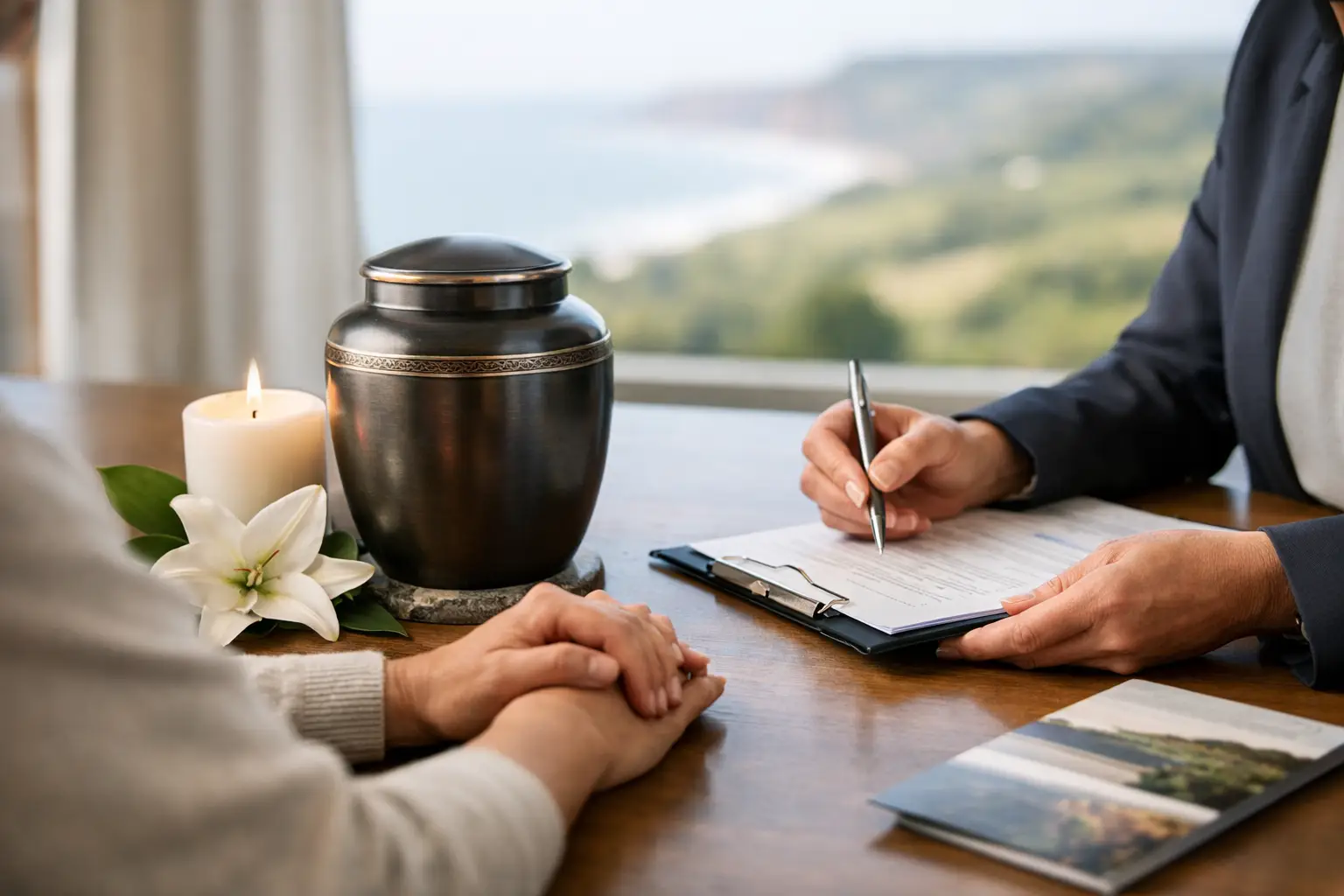

A death can leave a family with decisions to make before they have had time to take in what has happened. Knowing how to arrange cremation does not make the loss easier, but it can remove some uncertainty and give you space to focus on the person you love.
You do not need to have every answer straightaway. A good funeral director will talk through the practical steps at your pace, explain the choices without pressure, and make sure the arrangements reflect both your loved one’s wishes and your family’s needs.
The first steps after someone dies
What happens first depends on where and how the person died. If the death was expected at home, the GP surgery, district nurse or out-of-hours service can advise on confirming the death. If it was sudden, unexpected or there are concerns about the cause, contact the emergency services. The death may then be referred to the coroner, which can affect the timing of the funeral.
Once the death has been verified, you can contact a funeral director. You are not required to use the funeral director suggested by a hospital, care home or another organisation. You may choose an independent local firm that feels right for your family, and they can arrange for your loved one to be brought into their care.
The medical paperwork needed for cremation is more detailed than that used for burial. In most cases, the doctor will complete the Medical Certificate of Cause of Death and the death will be reviewed by an independent medical examiner before registration. Your funeral director can explain what is needed, liaise with the relevant professionals and guide you through the cremation authorisation.
Registering the death
In England and Wales, a death usually needs to be registered within five days, unless the coroner is involved. You will normally register it with the local register office for the area where the death occurred. The registrar will explain which documents are needed and issue the paperwork that allows the funeral arrangements to proceed.
If you are unsure who should register the death, it is usually a close relative, someone present at the death, an executor, or the person making the funeral arrangements. The registrar can also tell you about the Tell Us Once service, which helps notify government departments.
Try not to worry if documents or appointments feel unfamiliar. This is something many people do only once or twice in their lives. Ask questions, write down information when it is offered, and let others help where they can.
Choosing the kind of cremation
Cremation can be as simple or as personal as you wish. The right choice depends on your loved one’s wishes, your budget, whether family and friends need a place to gather, and what will bring the most comfort in the weeks ahead.
Direct cremation
A direct cremation is an unattended cremation, with no service at the crematorium. It is often the most modestly priced option and may suit someone who did not want fuss, or a family planning to hold a memorial later in a place that feels more personal.
A direct cremation does not mean a lack of care. Your loved one should still be collected respectfully, cared for with dignity and cremated at an agreed crematorium. Before choosing this option, ask how identification is managed, whether you can visit in the chapel of rest, what is included in the price and how ashes will be returned.
A simple or attended cremation
A simple cremation usually includes a short, quiet service at the crematorium, often with a limited number of mourners. It can provide an important moment to be together without the formality or cost of a larger funeral.
An attended cremation allows more freedom over the service. You may choose music, readings, photographs, flowers, a celebrant or minister, and time for people to speak. Some families hold the ceremony at a church, village hall or another meaningful venue before travelling to the crematorium. Others prefer a private committal followed by a separate celebration of life.
There is no correct level of ceremony. A small gathering can be every bit as meaningful as a full service, particularly when it reflects the person at its centre.
Making the arrangements personal
Personal touches do not need to be expensive or elaborate. A favourite piece of music, a photograph on the order of service, flowers from a garden, or a reading chosen by a grandchild can say a great deal.
Think about what mattered to the person: their family, work, faith, military service, hobbies, pets, garden, favourite places or sense of humour. These details can help shape a service that feels honest rather than formal for formality’s sake.
You will also need to decide who will lead the service. A religious minister may be right where faith was important. A civil celebrant can create a personal ceremony for families who want warmth and structure without religious content. Family members or friends may also wish to speak, though no one should feel obliged to do so. A written tribute can be read by the celebrant if that feels easier.
Understanding costs before you agree
Funeral costs vary according to the type of cremation, coffin, vehicles, service time, music, flowers, notices and other choices. Crematorium fees and doctors’ or other third-party charges may be included differently by different funeral directors, so it is sensible to ask for a clear written estimate.
Take time to understand what is included and what is optional. A transparent funeral director will never make you feel that care and dignity depend on choosing the most expensive option. You can ask about a basic funeral, direct cremation, payment arrangements and any help that may be available if money is a concern.
If your loved one had a funeral plan, locate the paperwork early. Check the provider, what the plan covers and whether there are additional costs, such as crematorium fees or personalised extras. The executor may also need to check whether funds are available from the estate.
Deciding what will happen to the ashes
You do not need to decide about ashes before the funeral. In many cases, they can be collected or held safely for a period while you consider your options. Some families keep ashes at home; others inter them in a cemetery, scatter them in a garden of remembrance, place them in a memorial jewellery piece or arrange a private scattering in a cherished place.
Scattering ashes on private land requires the landowner’s permission. For beaches, rivers, parks and other public places, check local guidance first and be considerate of other people using the area. If ashes are to be divided between relatives, discuss it openly where possible. What feels comforting to one person may feel difficult to another.
Families in East Devon sometimes choose a coastal setting because it held special memories, while others prefer the quiet certainty of a crematorium garden of remembrance. The most fitting choice is the one that gives you a sense of peace, not the one that seems expected.
Questions worth asking your funeral director
When arranging cremation, clear communication matters more than knowing the right terminology. Ask who will be your main point of contact, what paperwork they will handle, when the cremation can take place and whether you can visit your loved one. You may also want to ask about service times, accessibility, transport, coffins, ashes, payments and support after the funeral.
At Otter Valley Funerals, families are supported by people who understand that the smallest details can carry the greatest meaning. Whether you need a straightforward cremation or a service shaped around a full and distinctive life, you deserve patient answers and respectful care.
If decisions feel too much today, begin with one: speak to someone who will listen. The remaining choices can then be taken calmly, one at a time, with your loved one’s life and your family’s wellbeing at the heart of them.