
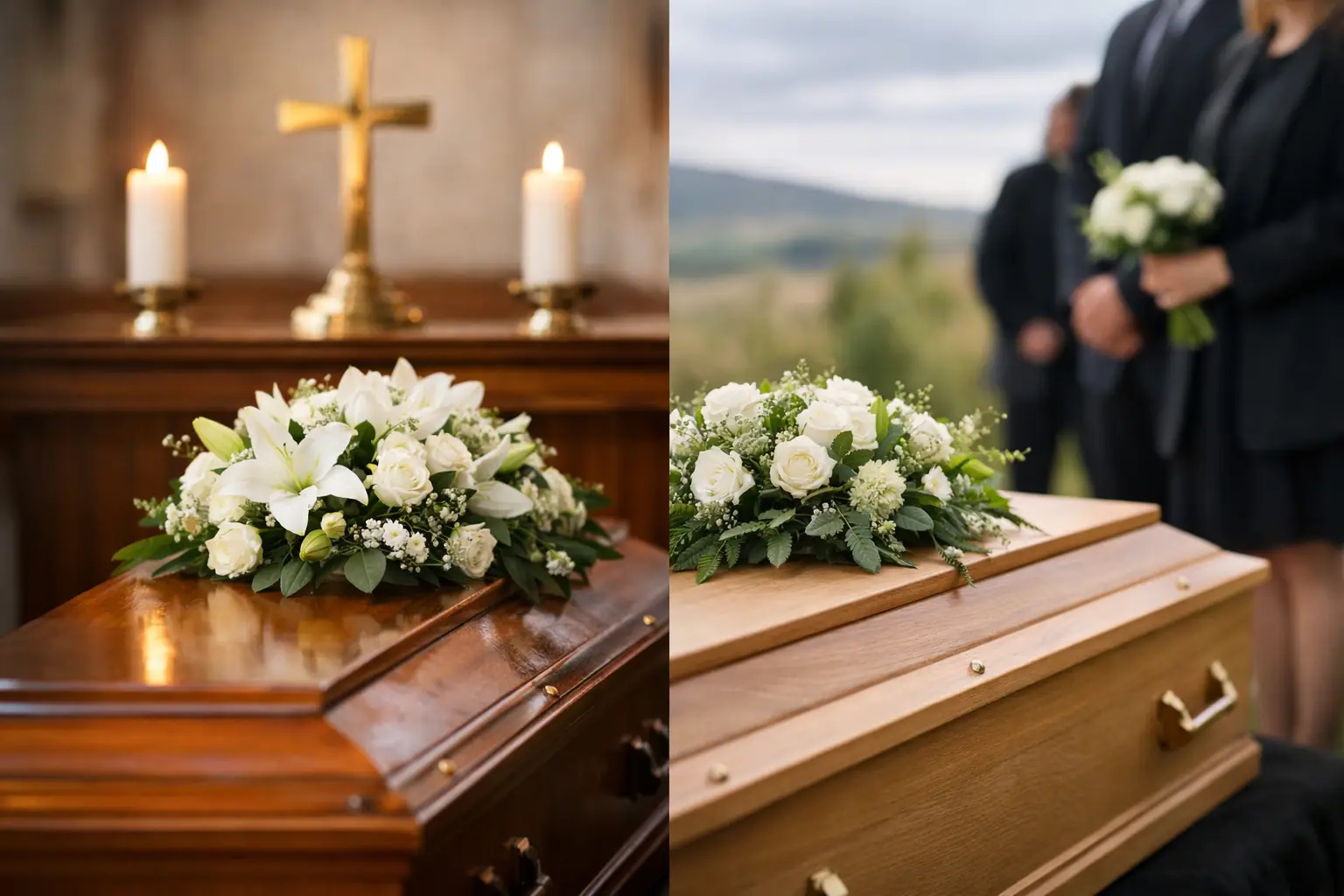

A familiar hymn can bring immediate comfort to one family, while another may feel that a favourite piece of music and personal stories say far more. Choosing a religious or nonreligious funeral is not about selecting the “right” type of service in general. It is about creating a farewell that feels honest to the person who has died, while giving those closest to them a way to gather, remember and say goodbye.
For many families, the decision is clearer than they expect. A person’s beliefs, their church connection, their wishes or the way they lived often point the way. Where feelings are mixed, a thoughtful conversation and a little flexibility can make room for everyone.
What is a religious funeral?
A religious funeral follows the traditions, prayers and readings of a faith. In this country, that may mean a Church of England service in a church, a Roman Catholic requiem, or a funeral led according to another Christian, Jewish, Muslim, Hindu, Sikh, Buddhist or other faith tradition.
The exact format varies considerably. A church funeral may include hymns, Bible readings, prayers, a sermon or address, and a blessing. It can be followed by burial in a churchyard or cemetery, or by a cremation committal. Some families choose a short service at a crematorium led by a minister rather than holding the main service in a church.
Faith can offer a familiar structure at a time when very little feels certain. The words, rituals and music may have been part of a loved one’s life for decades. For relatives who share that faith, the service can bring reassurance and a sense of continuity.
A religious service can also be personal. A minister or faith leader will usually want to hear about the person who has died: their character, family, work, interests and place in the community. This allows the service to reflect the individual, rather than feeling formal for its own sake.
What is a nonreligious funeral?
A nonreligious funeral, sometimes called a civil or humanist funeral, does not include worship or religious prayers as part of the service. It is often led by a civil celebrant or humanist celebrant, although a family member or friend may take a central role if that feels appropriate.
The focus is on the person’s life and the memories they leave behind. There may be a tribute, readings, poetry, photographs, music and contributions from family or friends. Some services are quiet and reflective; others are warm, humorous and full of stories. There is no single template.
A nonreligious funeral may take place at a crematorium, cemetery chapel, natural burial ground, private venue or, where suitable arrangements are made, in a setting that held special meaning for the person. The committal can be simple and dignified, with a few chosen words, a period of silence or a final piece of music.
Choosing a nonreligious service does not mean it has less depth or ceremony. For families who are not religious, it can provide the space to express love, gratitude and loss in language that feels true to them.
Religious or nonreligious funeral: how to decide
Start with the wishes of the person who has died. Look for a funeral plan, a will, written notes, a conversation they had with someone close, or details of a regular place of worship. Even an informal comment such as “I would like that hymn played” can be helpful guidance.
If no wishes were left, consider how they lived. Did faith shape their routine, values and relationships? Did they attend church at Christmas, for community events or regularly throughout their life? Or would they have preferred a service centred entirely on their family, achievements and personality?
It is also worth recognising that belief is not always straightforward. Someone may not have attended church for many years but still have found comfort in Christian prayers. Another person may have called themselves religious while wanting a very simple, lightly spiritual ceremony. A funeral does not have to fit neatly into one label.
When close relatives disagree, try to return to the question: what would feel most like them? This can be more helpful than debating what each person would choose for themselves. It may also be possible to include a small element that matters to a particular relative without changing the character of the entire service.
For example, a civil funeral might include a moment of quiet reflection rather than a prayer. A church service could include a favourite nonreligious song during a time of reflection, if the minister agrees. The right balance depends on the venue, faith tradition and the people involved, so it is sensible to discuss your ideas early.
Can a funeral include both religious and personal elements?
Yes, in many cases it can. The most meaningful funerals often combine tradition with the details that make a life recognisable.
At a religious funeral, the faith leader may welcome family memories, a personal eulogy, photographs displayed at the wake, or music chosen because it meant something to the person. At a nonreligious service, families may choose a poem with spiritual themes, a period of silence or words that acknowledge the beliefs of some mourners without presenting them as a shared act of worship.
The distinction matters most when planning a service in a church or according to a particular faith’s customs. There may be rules around music, readings, who leads the service and what can happen in the building. These are not intended to make things difficult. They protect the meaning of the place and the tradition. A good funeral director can help you understand what is possible and speak with the minister, celebrant or venue on your behalf.
The practical choices around the service
The type of funeral affects some practical arrangements, but it does not determine every decision. Both religious and nonreligious funerals can be followed by cremation or burial. Both can include a limousine, family bearers, floral tributes, printed orders of service, a reception afterwards or a more modest gathering.
You may prefer a traditional church funeral followed by burial, a simple crematorium ceremony with a celebrant, or a direct cremation followed by a memorial gathering at a later date. A green funeral or natural burial can also be religious or nonreligious, depending on the words and rituals chosen.
Think, too, about who will be present. A service with a clear structure can be reassuring for a large group of mourners. A smaller ceremony may allow more people to speak and share memories. If relatives are travelling to East Devon, the timing of the service, venue accessibility and the opportunity to gather afterwards may all influence the plan.
Cost is naturally a consideration for many families. The fees for a church, minister, celebrant, crematorium or burial ground differ, as do choices such as vehicles and printed materials. Asking for clear, itemised costs from the beginning helps you make decisions without uncertainty or pressure.
Giving family and friends a role
Whether the service is religious or nonreligious, people often value having a small part to play. A granddaughter might read a poem, a neighbour may share a short memory, or a friend may carry the coffin. These contributions do not need to be polished. Their value comes from being personal.
If speaking in public feels too difficult, someone can choose music, write a few words for the officiant to read, help select photographs or greet people as they arrive. No one should feel obliged to take on a role while grieving, but offering gentle options can help family members feel included.
Children can be included in simple, age-appropriate ways too. They might place a flower on the coffin, draw a picture, select a song or attend only part of the day. It is usually better to explain what will happen in clear, calm terms than to leave them feeling excluded or uncertain.
A farewell that feels true
There is no need to choose a religious funeral simply because it is traditional, and no need to choose a nonreligious funeral because it seems simpler. Each can be formal or informal, quiet or celebratory, traditional or deeply individual.
What matters is that the farewell reflects the person at its centre and gives the people who loved them a place to begin grieving together. If you are unsure, Otter Valley Funerals can talk through the options with care, explain the practical arrangements and give you time to make choices that feel right for your family.
Pingback: Best Funeral Poems for Mum to Read with Love - Otter Valley Funerals Funeral Director for Exmouth and Budleigh