


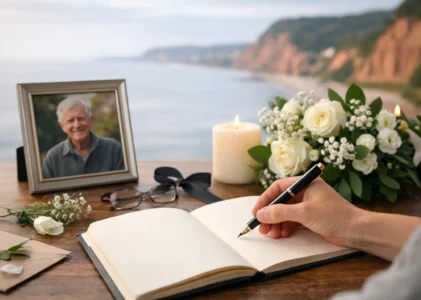
When someone dies, there can be a great deal to arrange in a short time. Funeral notices and tributes offer a way to share the practical details of the funeral while giving family, friends and the wider community a chance to recognise a life that mattered. They do not need to be perfect or formal. The most meaningful words are usually the ones that sound like the person being remembered.
The different purpose of a notice and a tribute
A funeral notice is primarily practical. It lets people know that someone has died and explains when and where the funeral or celebration of life will take place. It may appear in a local newspaper, online, on a funeral director’s notice page or be shared directly with friends and family.
A tribute is more personal. It can be a few warm sentences within the notice, a longer piece read during the service, or a message shared afterwards. Its purpose is not to capture every part of a person’s life. It is to offer a truthful glimpse of who they were and what they meant to others.
Many families choose to combine the two. A brief notice can state the arrangements, followed by a few words about a devoted parent, a loyal friend, a familiar face in the community or someone remembered for their humour. This approach is especially helpful when people wish to welcome others to the service while keeping the announcement gentle and personal.
What to include in a funeral notice
There is no fixed wording, but a clear notice usually answers the questions people will need to ask. Begin with the person’s full name, and include a maiden name, nickname, title or place they were known from if that feels appropriate. You may wish to give their age, although this is entirely a family decision.
The notice can then say that they died, often with a simple phrase such as “passed away peacefully” or “died surrounded by family”. Only include details you are comfortable sharing publicly. Some families prefer not to mention the circumstances of a death, and there is no obligation to do so.
Next, provide the funeral arrangements: the date, time and location, and whether the service is open to all or by invitation only. If there is a gathering afterwards, it can be helpful to say where it will be held. Clear directions are particularly considerate where a church, crematorium or natural burial ground may be unfamiliar to some guests.
You can also include practical requests. These might include family flowers only, a preferred charity for donations, or a request for bright clothing rather than traditional mourning dress. Keep this wording straightforward. For example: “Family flowers only, please. Donations, if desired, in memory of John may be given to…”
Before publishing, ask another family member to check every name, date and venue detail. During bereavement, it is easy to miss a small error, and a second pair of eyes can prevent unnecessary worry.
Finding the right words for a tribute
Writing about someone you love can feel harder than completing the practical arrangements. You may be concerned that you will leave something out, choose the wrong tone or be unable to find words that are sufficient. There is no need to tell their whole story at once.
Start with one or two things that immediately bring them to mind. Perhaps they never missed a grandchild’s birthday, loved walking the Devon coast, made the best roast dinner, cared for their garden, or had a phrase everyone in the family can still hear. Specific memories feel more real than grand statements.
It can help to think in three small parts: who they were, what they valued, and what they leave behind. A tribute might describe a person as a patient listener, mention their love of music or football, then reflect on the family and friendships that will carry their memory forward. This simple shape gives the words warmth without making them feel over-written.
Honesty matters more than polish. A person can be remembered as funny, determined, generous, private, mischievous or occasionally stubborn. Gentle humour is often welcome when it genuinely reflects their character. The aim is respect, not solemnity for its own sake.
Keep it in your own voice
A tribute does not need poetic language to be moving. Plain words such as “We will miss his mobile phone calls” or “She made everyone feel at home” can say far more than a formal phrase that no one in the family would naturally use.
If several people are contributing, invite them to send a favourite memory, a quality they admired, or a short story. You may notice themes emerging: kindness, practical help, resilience, a sense of fun, love of family. These details can be woven together, rather than trying to include every contribution word for word.
Choosing the right length and level of detail
The best length depends on where the tribute will appear. A newspaper notice may have a cost based on length, so families often choose a concise announcement with one or two personal lines. An online notice can allow more room for a fuller tribute and messages from others.
For a funeral service, a tribute of around three to five minutes is often enough to hold people’s attention and leave space for music, readings, reflection and other speakers. If a life was long and full, it may be better to choose a few defining moments than to recite a complete timeline.
Privacy also deserves careful thought. Funeral notices can travel widely online and through social media. Consider whether addresses, detailed family circumstances, medical information or personal disagreements should be kept out of the public notice. A more private gathering may call for a simple announcement shared directly with those invited.
When family members have different views
It is common for relatives to have different ideas about the notice, the tone of a tribute or who should be named. Grief can make even small decisions feel weighty. Where possible, agree the purpose first: are you informing the community, inviting people to the service, or creating a lasting public remembrance?
One person can then prepare a draft, while others suggest factual corrections or additions. Trying to write every sentence as a group can become tiring at an already difficult time. If there are sensitive relationships or strongly differing views, it may be kinder to keep the published wording simple and save more personal memories for the service or a private gathering.
A funeral director can also help by checking service details, arranging publication and making sure any donation instructions are clear. At Otter Valley Funerals, families can be supported with these practical tasks, leaving more space to focus on the person they are saying goodbye to.
A simple approach when words will not come
Sometimes the blank page is the hardest part. Begin with their name and write one sentence as though you were explaining them to someone who had never met them. Then add a memory you would not want to lose. Stop there if that is all you can manage initially.
You might write: “Margaret was a much-loved mum, nan and friend, known for her generous spirit and the kettle that was always on.” This is short, but it gives people a clear sense of her. More can be added later if needed.
There is also no requirement to write or speak a tribute yourself. A celebrant, minister, family friend or another relative can read it on your behalf. The words remain yours, even if someone else lends their voice on the day.
A funeral notice tells people where and when to gather. A tribute reminds them why they came: to share grief, gratitude and memories of someone whose life touched their own. Give yourself permission to keep the words simple, take your time where you can, and choose what feels true to the person you love.