

Choosing a funeral can feel especially difficult when you are trying to balance grief, practical decisions and a loved one’s values. This guide to green burials is here to make that process clearer, so you can understand what a natural burial involves and whether it feels right for your family.
For many people in East Devon, a green burial offers something simple and honest. It can feel less formal than a traditional cemetery burial, with more emphasis on the natural setting, fewer artificial materials and a gentler environmental impact. For others, it is not only about sustainability. It is about choosing a peaceful resting place that reflects a love of the countryside, simplicity or a wish to leave a lighter footprint.
What is a green burial?
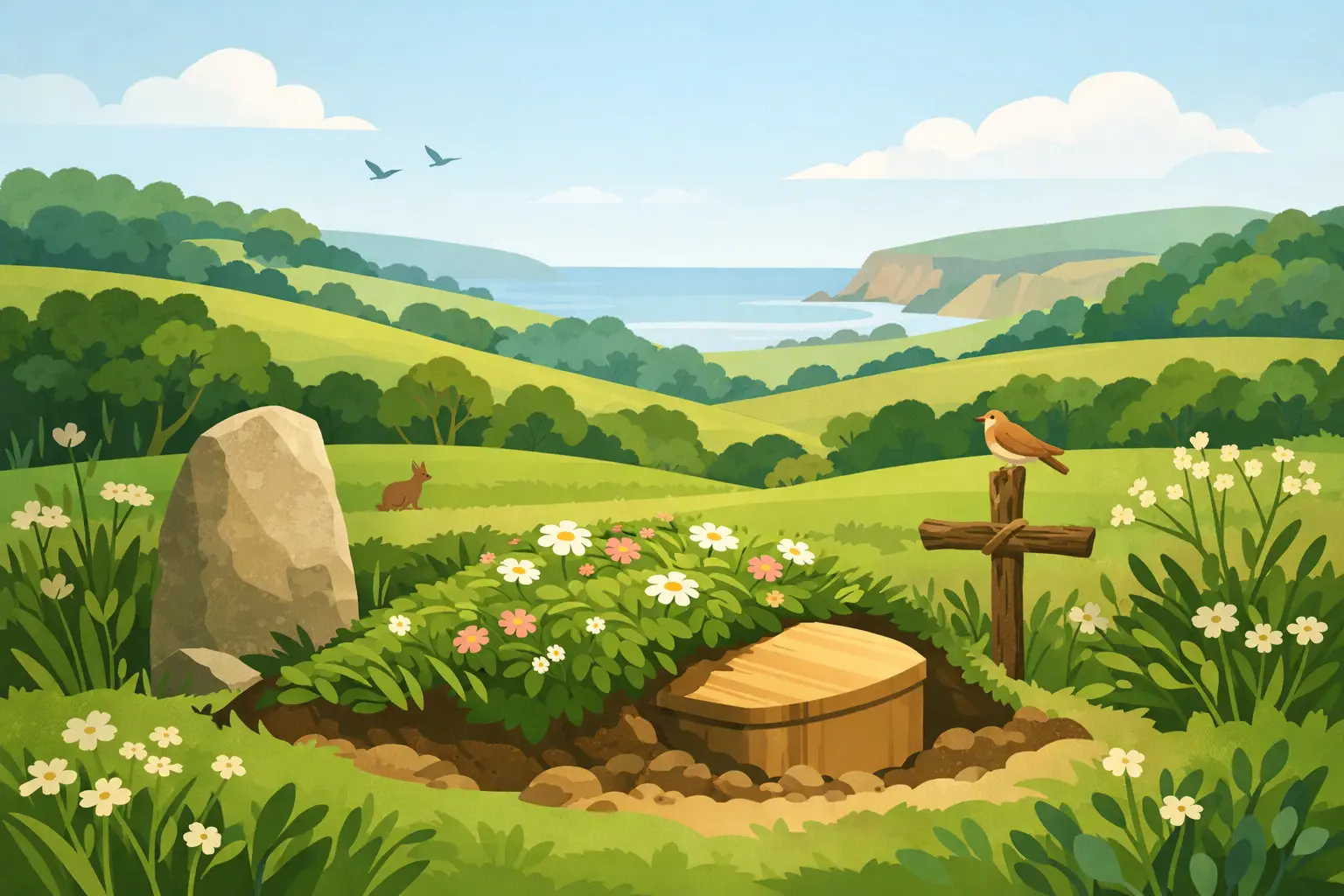
A green burial, sometimes called a natural burial, is a burial arranged in a way that reduces environmental impact. The person is usually laid to rest in a biodegradable coffin, casket, shroud or other approved container, in a burial ground that is managed to support the natural landscape rather than a heavily manicured cemetery setting.
That often means no traditional headstones, no concrete burial vaults and limited use of non-biodegradable materials. Instead of polished memorials, some natural burial grounds use trees, wildflowers, simple plaques or careful mapping to mark graves.
The exact rules vary from site to site, which matters more than many families expect. One burial ground may allow a memorial tree, while another may not. Some permit cut flowers, others ask families to avoid them. A funeral director can help explain those differences before you make any decisions.
Why families choose a guide to green burials
People come looking for a guide to green burials for different reasons. Some want the most environmentally conscious option available. Others are not looking for a statement at all – they simply want something modest, meaningful and less conventional than a traditional funeral.
There is also a growing awareness that funerals do not have to follow one fixed pattern. A green burial can still include all the elements that matter to a family: a service, music, readings, time to gather, a procession and a chance to say goodbye properly. The setting may be different, but the care and dignity remain the same.
For some families, a natural burial feels more personal because it removes some of the formality. For others, that same simplicity may feel unfamiliar. Neither response is wrong. The right choice depends on the person who has died, the wishes they expressed and what brings comfort to those left behind.
What makes a burial “green”?
The term covers a few different choices, and not every green funeral looks exactly the same. In most cases, the environmental benefits come from the materials used and the way the burial ground is managed.
A biodegradable coffin is one of the main features. These may be made from wicker, cardboard, bamboo, seagrass, wool or untreated wood. A burial shroud may also be possible, although each burial ground has its own requirements. Clothing is usually made from natural fibres, and embalming is often avoided unless there is a clear reason for it.
The burial ground itself also plays a large part. Natural burial sites are often managed as meadow, woodland or pasture rather than formal lawn cemeteries. Some contribute to conservation or habitat protection, though this varies, so it is worth asking how the land is cared for in practice.
It is also worth saying that green funerals are not all-or-nothing. Some families choose a natural coffin but hold a service in a church. Others choose a simple hearse route and fewer floral tributes. A funeral can include greener choices without every element being strictly natural.
How a green burial differs from a traditional burial
The biggest differences are usually the setting, the materials and the memorial options. A traditional burial often takes place in a cemetery or churchyard, with a hardwood coffin, formal grave marker and more conventional funeral arrangements. A green burial tends to be simpler in appearance and more flexible in spirit.
That said, simplicity does not mean a lack of ceremony. Families can still have pallbearers, hymns, celebrants, clergy, family tributes and moments of quiet reflection. Some choose wellington boots and wildflowers; others prefer suits, formal readings and a more familiar structure. A natural burial does not remove those choices.
One practical difference is long-term memorialisation. If having a permanent engraved headstone is important to your family, a natural burial ground may not be the best fit. Some people find great comfort in a named stone they can visit. Others feel equally comforted by a tree-lined meadow or a shared remembrance area. This is one of the main areas where personal preference really matters.
Costs and what affects them
Green burials can sometimes be more affordable than traditional burials, but not always. Much depends on the burial ground fees, the type of coffin chosen, transport, the service itself and whether there are extra costs for local residency or exclusive memorial options.
A simple biodegradable coffin may cost less than an ornate traditional coffin. On the other hand, some natural burial grounds charge fees that are comparable to, or higher than, local cemetery charges. If you are comparing options, it helps to look at the full picture rather than assuming one route will automatically be cheaper.
Families often appreciate transparent pricing at this stage, especially when decisions need to be made quickly. A clear breakdown can make it easier to see where you may want to keep things simple and where you may wish to spend more for personal reasons.
Questions to ask when arranging a natural burial
When using any guide to green burials, the most useful step is asking practical questions early. Not all sites have the same policies, and small details can shape your decision.
You may want to ask what coffin or shroud materials are accepted, whether embalming is permitted, what memorials are allowed, whether faith-led or non-religious services can be held on site, and whether the grave can be visited freely in future. It is also sensible to ask about ground conditions in winter, parking and accessibility for older relatives or guests with mobility needs.
If family members are travelling from further afield, location may matter just as much as philosophy. A beautiful burial ground can feel less suitable if it is difficult for close relatives to reach or revisit.
Planning ahead for your own wishes
Many people who enquire about green funerals are planning ahead rather than arranging a funeral immediately. That can be a real kindness to the family who will one day need to carry out those wishes.
If you know that a natural burial is important to you, it helps to write down more than the headline choice. Note whether you prefer a woodland or meadow setting, whether you would want a religious service, whether there is particular music or dress you would like, and whether there are charities or flowers you would prefer. The more clearly your wishes are recorded, the easier it is for others to feel confident they are doing what you wanted.
Pre-planning also gives you time to weigh up the trade-offs. For example, you may love the idea of a natural burial but still want a family grave with a visible memorial. Those wishes can sometimes pull in different directions, and it is better to think them through calmly rather than leaving loved ones to guess.
Finding the right support
When you are arranging any funeral, practical guidance matters just as much as kindness. A green burial may sound straightforward, but there are still forms to complete, timings to manage and choices to confirm with the burial ground and the people leading the funeral.
Working with a funeral director who understands both the practical side and the personal side can make a difficult time feel more manageable. For local families, having someone nearby who can answer questions plainly, explain the options without pressure and respect both budget and personal wishes can make all the difference. That is why many families choose an independent firm such as Otter Valley Funerals, where support is personal and decisions are handled with care.
A green burial is not the right choice for every family, and it does not need to be. What matters most is that the funeral feels fitting, respectful and true to the person being remembered. If a natural burial offers that sense of peace, then it may be one of the gentlest ways to say goodbye.