

For many families, the question is not whether they want a meaningful farewell, but how to make it feel right. Green funeral options often come into the conversation at that point – not as a trend, but as a reflection of someone’s values, love of the countryside, or wish to leave a lighter footprint.
In East Devon, where landscape and community matter deeply, this choice can feel especially personal. Some people are planning ahead for themselves. Others are making decisions after a death and trying to balance grief, cost, family wishes and practical arrangements. A greener funeral can absolutely still be dignified, beautiful and carefully organised. It simply approaches those goals a little differently.
What do green funeral options usually mean?
The phrase covers a range of choices that aim to reduce environmental impact. That may involve the type of coffin used, whether embalming is avoided, the choice between burial and cremation, how people travel to the service, or where the funeral takes place.
For some families, a green funeral means a natural burial in a meadow or woodland setting. For others, it may mean keeping a cremation simple, choosing fewer vehicles, using seasonal flowers, or avoiding materials that do not break down naturally. There is no single correct version. The best arrangements are usually the ones that reflect the person who has died and feel manageable for the people left behind.
That matters, because families can sometimes worry that choosing an environmentally gentler funeral means giving something up emotionally. In practice, the opposite is often true. Simpler decisions can create more space for what feels personal and sincere.
Natural burial and other green funeral options
Natural burial is one of the most recognised green funeral options. It usually involves burial in a dedicated natural burial ground or cemetery area where the emphasis is on conservation and minimal environmental disruption. Graves may be marked in a modest way, or sometimes not at all, depending on the site’s rules.
This option often appeals to people who loved nature, disliked fuss, or wanted their funeral to contribute to the land rather than take from it. A biodegradable coffin or shroud is typically required, and embalming is usually discouraged or not permitted.
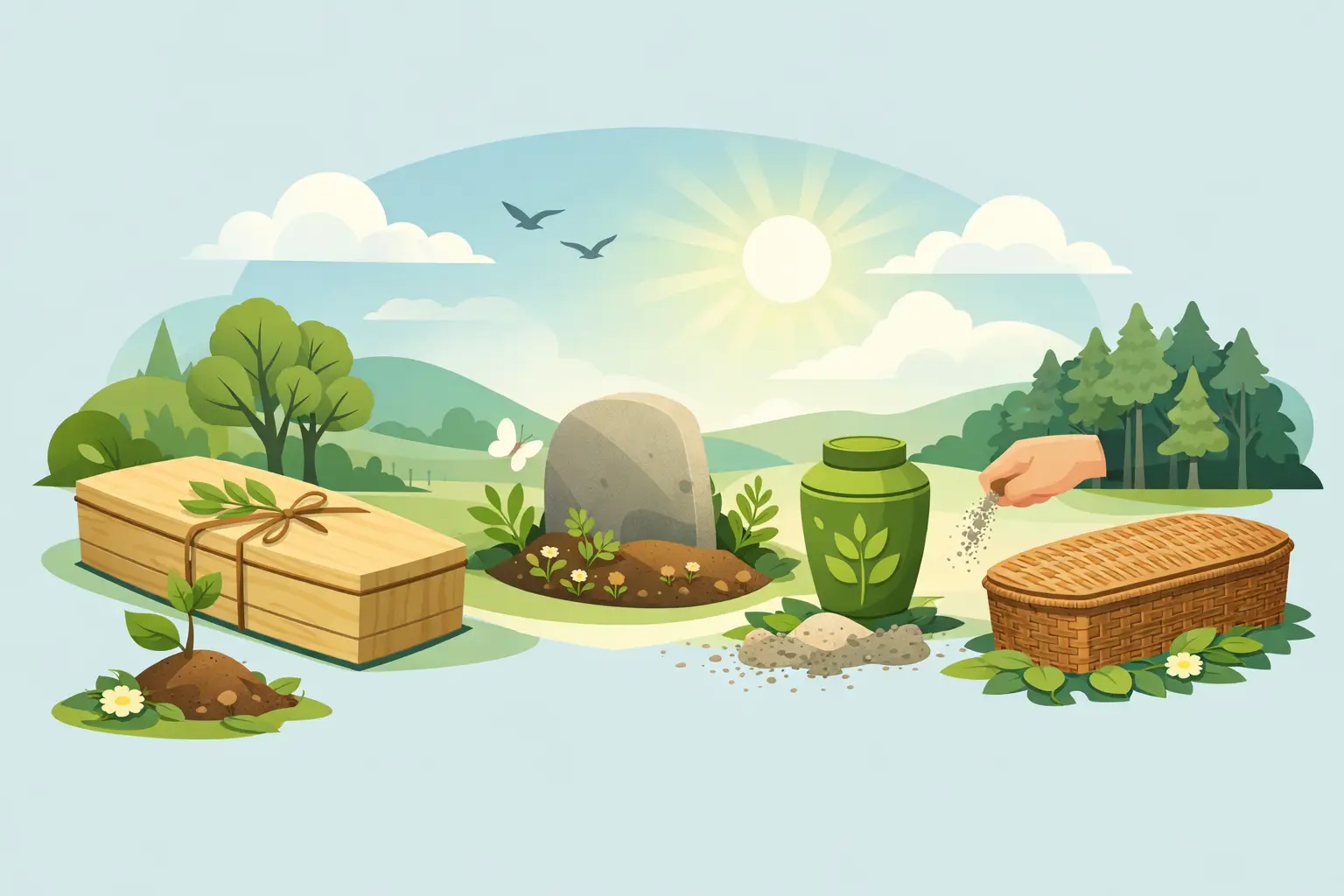
That said, natural burial is not the only route. A greener approach can also be built into a more traditional funeral. A family may choose a simple coffin made from untreated wood, wicker, cardboard or other biodegradable materials. They may decide against laminated orders of service, floral foam, or large vehicle processions. They may hold a smaller service and focus spending on what matters most to them.
Cremation can also be adapted with environmental impact in mind, though it is worth being honest that cremation itself uses energy and has its own footprint. Families who prefer cremation may reduce impact through simpler arrangements, thoughtful memorial choices and fewer unnecessary extras. It is often a matter of balance rather than perfection.
The choices that make the biggest difference
The coffin is often one of the first things families think about. Traditional coffins can include metal fittings, synthetic linings and finishes that are less suitable for natural burial. A greener coffin tends to use natural, biodegradable materials and simpler construction. Cardboard, bamboo, willow, seagrass and untreated wood are all common choices.
Embalming is another important consideration. It is not always necessary, particularly if the funeral is taking place within a reasonable timeframe and suitable care is available. Some families find reassurance in knowing that avoiding embalming can be more in keeping with a natural approach.
Transport is sometimes overlooked, but it can have a noticeable effect on the footprint of the day. Some families choose a single hearse and ask mourners to share lifts. Others prefer to meet directly at the venue. In some cases, especially with local services, a less formal arrangement feels entirely appropriate.
Flowers and printed items also deserve thought. Locally grown, seasonal flowers are often a better choice than imported arrangements, and some families ask for donations in memory instead of floral tributes. Orders of service can be kept simple, printed on recycled paper, or replaced with a spoken welcome and shared readings.
None of these decisions needs to be made from a place of pressure. They are simply options that can be adjusted to suit the person, the budget and the kind of farewell a family wants to create.
What families often worry about
One common concern is whether a green funeral will feel too informal. The answer depends entirely on how it is planned. Natural does not mean careless. Simple does not mean cold. A funeral can be environmentally conscious and still be conducted with great dignity, warmth and attention to detail.
Another worry is cost. Some green choices can be more affordable, particularly where families opt for simpler coffins or fewer formal elements. But this is not always the case. Natural burial fees vary by location, and some bespoke eco-friendly products can cost more than expected. It is always worth asking for clear prices early on so there are no surprises.
Families also sometimes worry about whether older relatives will understand or approve. This is where careful explanation helps. Most people respond well when they can see the reasoning behind the choices – especially when those choices reflect the wishes or character of the person who has died.
Planning a funeral that feels both personal and practical
The most helpful starting point is usually not the environmental detail, but the person themselves. Were they someone who loved the sea, the countryside, gardening, simplicity, or community? Did they ever speak about not wanting a fuss, or wanting things done in a straightforward way? Those clues often guide the arrangements more naturally than any checklist.
From there, practical decisions become easier. Burial or cremation is usually the main one. After that, it helps to consider what matters most on the day itself. Some families want a quiet committal followed by a gathering elsewhere. Others want the ceremony to take place outdoors, if permitted. Some want traditional elements kept in place but adapted where possible.
This is often where a family-run funeral director can make a real difference. Personal guidance matters when you are weighing up what is possible, what is allowed at a particular venue, and what will work best for those attending. At Otter Valley Funerals, these conversations are handled gently and clearly, so families can make informed choices without feeling rushed.
Green funeral options when planning ahead
If you are thinking about your own funeral wishes, green funeral options are well worth setting out in advance. Even a few written preferences can lift a great deal of uncertainty from your family later. You do not need every detail decided, but it can help to note whether you would prefer natural burial or cremation, what kind of coffin you would want, and whether there are things you would rather avoid.
Planning ahead also gives you time to ask questions properly. For example, some people assume a natural burial ground will allow any kind of memorial, when that is not always the case. Others feel strongly about a certain setting or type of service and want to know what would be realistic in Devon.
Advance planning is not about being gloomy. Very often, it is about care. It gives your family something solid to follow at a time when clear thinking may be difficult.
A gentler approach, not a rigid one
Perhaps the most important thing to say is that greener funerals do not have to meet a perfect standard. Families are often carrying enough already. If a natural coffin feels right but a church service still matters, those things can sit together. If cremation is the practical choice but you want to reduce extras and keep the tone simple, that still counts as a thoughtful decision.
The kindest approach is usually the most realistic one. A funeral should honour the person who has died, support the people who are grieving, and sit comfortably with the values of the family. Environmental impact is part of that picture, but it is not the whole picture.
When choices are made with care, honesty and respect, they tend to feel right. And for many families, that is what green funeral options are really about – not doing everything, but doing what matters in the most thoughtful way possible.