
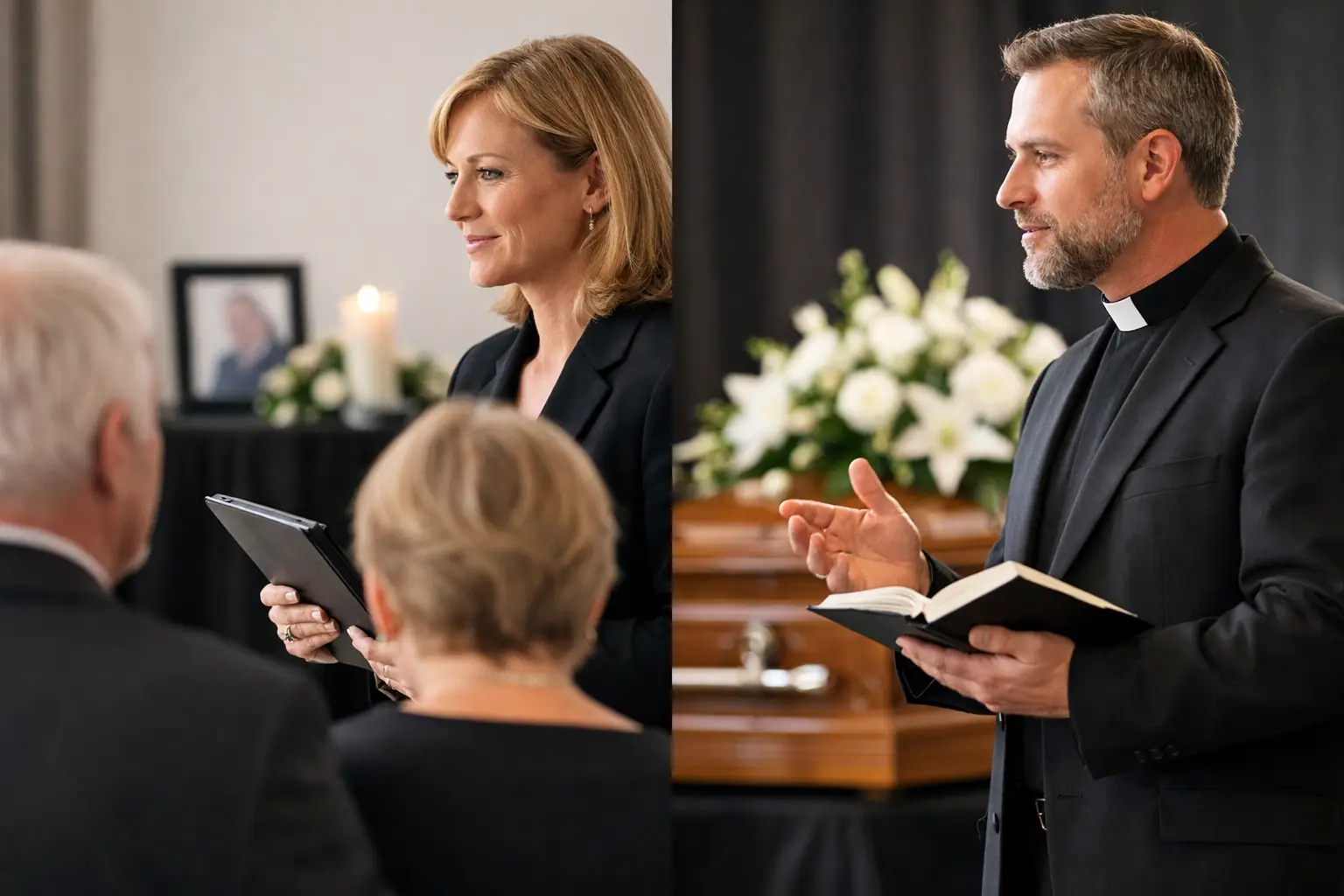

When someone dies, families are often asked a question they were not expecting to answer so quickly: would you like a funeral celebrant or minister to lead the service? In the middle of grief, that choice can feel larger than it sounds, because the person leading the funeral shapes the tone, structure and language of the farewell.
For some families, the answer is immediate. Their loved one had a strong Christian faith, attended church regularly, or had clear wishes for a religious funeral. For others, it is less straightforward. They may want warmth, meaning and dignity without a formal act of worship. That is usually where the difference between a celebrant and a minister becomes important.
Funeral celebrant or minister – what is the difference?
A minister is a religious leader, most commonly from the Church of England or another Christian denomination, who leads a funeral service from within the traditions of their faith. That may include prayers, hymns, Bible readings and a message of comfort rooted in Christian belief. If your loved one was a person of faith, or your family takes comfort in familiar religious words and customs, a minister may feel like the right person to lead the service.
A funeral celebrant usually leads a non-religious or lightly religious service. Their role is to create a ceremony centred on the person who has died, reflecting their character, life story, relationships and values. A celebrant can include music, poems, memories, tributes and moments of quiet reflection. Some celebrants also include a prayer or short reading if the family would like that, so the service does not have to be strictly secular.
In simple terms, a minister leads from faith tradition, while a celebrant leads from the life and wishes of the person being remembered. Neither is better in every case. It depends on what would feel most honest, most comforting and most fitting.
When a minister may be the right choice
If your loved one was an active churchgoer, had a long connection with their parish, or spoke clearly about wanting a religious funeral, a minister is often the most natural choice. There can be comfort in hearing words and prayers that have carried families through loss for generations.
A minister may also be especially appropriate if the funeral is taking place in a church. In that setting, the service often follows a recognised pattern, with time for prayer, scripture and reflection on eternal hope. For many families, that structure brings reassurance when emotions are raw and decision-making feels hard.
There is also a sense of pastoral care that some ministers offer before and after the funeral. If the family already knows them, or if the deceased was part of the church community, there may be a personal relationship that adds depth to the service.
That said, it is worth being realistic about style. Some ministers are very flexible and warm in their approach. Others may need the service to remain more traditionally religious. If your family wants a great deal of personal storytelling, modern music or a less formal tone, it is sensible to ask what can be included.
When a funeral celebrant may feel more suitable
A celebrant is often the right choice when the person who has died was not religious, did not attend church, or would have preferred the focus to be on their life rather than on formal worship. Many families also choose a celebrant because they want more freedom in how the service is written and delivered.
A good celebrant will usually spend time getting to know the family and learning about the person behind the name. That can mean hearing the small details as well as the milestones – the habits that made them themselves, the stories people still laugh about, the music they loved, the places that mattered, and the values they lived by.
This often allows for a very personal ceremony. The tone can be gentle, uplifting, reflective or quietly informal, depending on what suits the individual. If the family wants to include grandchildren reading a poem, a favourite song that would not usually appear in a church service, or a tribute written in plain, everyday language, a celebrant can often accommodate that more easily.
For crematorium services, woodland funerals and celebrations of life, celebrants are a common choice because they can adapt the ceremony to fit the setting. The service can still be deeply respectful and moving without being overtly religious.
It does not always have to be one or the other
Many families assume they must choose between a fully religious service and a fully non-religious one, but that is not always the case. The right balance is often somewhere in the middle.
Some celebrants are happy to include the Lord’s Prayer, a hymn or a short moment of spiritual reflection. Equally, some ministers are very open to personal tributes, contemporary music and less formal language. If your family includes both practising Christians and relatives who are not religious, a blended approach may help everyone feel included.
This is where careful guidance matters. The best funeral services are not built around labels. They are built around the person who has died and the people who are gathering to remember them.
Questions that can help you decide
If you are unsure whether a funeral celebrant or minister is right, it often helps to think less about the title and more about the person being honoured. Ask yourself what they would have chosen if they had been able to decide.
Did faith shape their daily life, their values and their sense of comfort? Did they belong to a church or speak about religion as a source of strength? If so, a minister may feel right.
Or was their identity more closely tied to family, work, community, music, humour or personal beliefs outside organised religion? If that sounds more familiar, a celebrant may be a better fit.
You can also think about the atmosphere you want in the room. Some families want the familiarity and reverence of a church-led service. Others want something more conversational and personal. Most want dignity either way, but dignity can take different forms.
Practical questions matter too. Where is the funeral taking place? Are there particular readings or hymns you want included? Is there a minister who knew your loved one, or a celebrant whose style feels right for your family? These details can shape the decision just as much as belief.
The person leading the service matters as much as the role
Whether you choose a celebrant or a minister, the individual themselves makes a real difference. Two celebrants may lead services very differently. The same is true of two ministers.
What families usually need is someone who listens well, speaks with care, and understands how to hold a room with kindness and confidence. The right person will respect your wishes, explain what is possible and help create a service that feels true.
That is why it can be helpful to ask how they work. Will they meet with the family beforehand? Will they help shape the wording of the service? Can they adjust the tone to suit a quiet cremation, a larger church funeral or a more personal celebration of life? Good guidance at this stage can remove a great deal of uncertainty.
Choosing with confidence during a difficult time
There is no perfect formula for deciding between a funeral celebrant or minister. Some choices are clear because the person left firm wishes. Others are made gently, with the family weighing what feels most respectful and most comforting.
In our experience, families rarely regret choosing the option that feels most authentic. A simple service led with warmth and honesty will usually mean more than a ceremony that follows expectations but does not quite reflect the person who has died.
If you are arranging a funeral in Budleigh Salterton, Exmouth or the surrounding area, it can help to talk through the options with someone who knows how different services work in practice. The right advice should never pressure you in one direction. It should help you feel calm, informed and supported enough to make the choice that fits your loved one.
At the heart of it, this decision is not really about job titles. It is about voice, presence and the kind of goodbye your family needs. Choose the person who can tell that story with care.